You've probably tried melatonin. Maybe magnesium. You've cut caffeine after noon, put your phone face-down, bought blackout curtains. And somewhere along the way, you came across the idea that red light is good for sleep. It sounds like another wellness trend. That scepticism is fair.
But this one actually has a mechanism behind it.
Why the colour of light matters more than the brightness
Your brain's sleep system doesn't care much about brightness. It cares about wavelength.
Inside your eyes, alongside the rods and cones used for ordinary vision, there's a third type of light-sensitive cell. They're called intrinsically photosensitive retinal ganglion cells, or ipRGCs. These cells contain a photopigment called melanopsin. Melanopsin is tuned specifically to short-wavelength light. Blue light. Roughly 460–490 nanometres.
When melanopsin detects blue light, it fires a signal to the suprachiasmatic nucleus (SCN). That's the small cluster of neurons in your hypothalamus that acts as your body's master clock. The message it receives is simple: it's daytime. Stay awake. Hold off on melatonin.
Melanopsin is not particularly sensitive to long-wavelength light. The red and amber end of the spectrum. The signal it sends when exposed to red light is much weaker. Sometimes negligible.
That's the biological fact everything else rests on.
What blue and white light do to your brain after sunset
Your overhead lights, bathroom globe, kitchen strip lights, and phone screen are all doing the same thing: sending a daytime signal to your circadian system at 10pm.
Standard household bulbs emit a broad spectrum. Incandescent, fluorescent, most LEDs. They all contain significant blue-wavelength energy. Your brain doesn't know it's 10pm. It knows only what the light is telling it.
When that signal arrives, melatonin production is delayed. Melatonin isn't a sleeping pill. It's a timing signal. A hormonal cue that tells your body night has arrived and the biological wind-down can begin. When the cue is delayed, everything downstream is delayed too. Core body temperature stays higher. Heart rate doesn't settle. The stress system stays engaged.
Research from Harvard's Division of Sleep Medicine found that blue light suppresses melatonin for roughly twice as long as green light. Studies on overhead light exposure in the two to three hours before bed show measurable delays in sleep onset.
It's not one bright screen that causes the problem. It's accumulated exposure across an entire evening. Every light source in every room you move through before bed.
So, is red light good for sleep?
Red light doesn't trigger the same suppression signal that blue light does.
It sits at the long-wavelength end of the visible spectrum. Roughly 620–700 nanometres. At that wavelength, melanopsin is far less activated. The circadian signal is weaker. Melatonin isn't suppressed in the same way.
That's not the same as saying red light actively induces sleep. It doesn't work like a sedative. What the research suggests is closer to this: red light is largely neutral to your melatonin system. It allows your natural sleep-onset biology to proceed without interference.
Your body has a biological process that kicks in after sunset, when light fades. That process can be interrupted by the wrong kind of light. Red light, by virtue of its wavelength, doesn't interrupt it. The distinction is not "red light makes you sleepy" but rather "red light doesn't get in the way."
One thing worth clarifying: red light therapy devices (red and near-infrared LED panels used for muscle recovery or skin treatment) are a different application entirely. We're talking here about red-spectrum ambient lighting. Different tools, different purposes, different evidence base.
Red light bulbs for bedroom and bathroom use
Long-wavelength red light doesn't interfere with melatonin the way blue and white light does. The practical question is where in your home that actually matters.
The bedroom is the obvious answer, but it's often not the most important room. If you're already in bed with the lights off, the problem is largely solved.
The rooms that cause the most disruption are the ones you move through in the hour before bed. And the ones you encounter if you wake up at night.
Bathroom. Most people use the bathroom before bed and again in the middle of the night. A standard LED bathroom globe can produce significant blue-spectrum output. Two minutes under that light at 2am is enough to send a measurable circadian signal to your brain.
Hallway. The hallway is the transition between your lit living areas and your bedroom. A red light in a hallway fitting means your last few minutes before bed aren't spent under a blue-rich overhead.
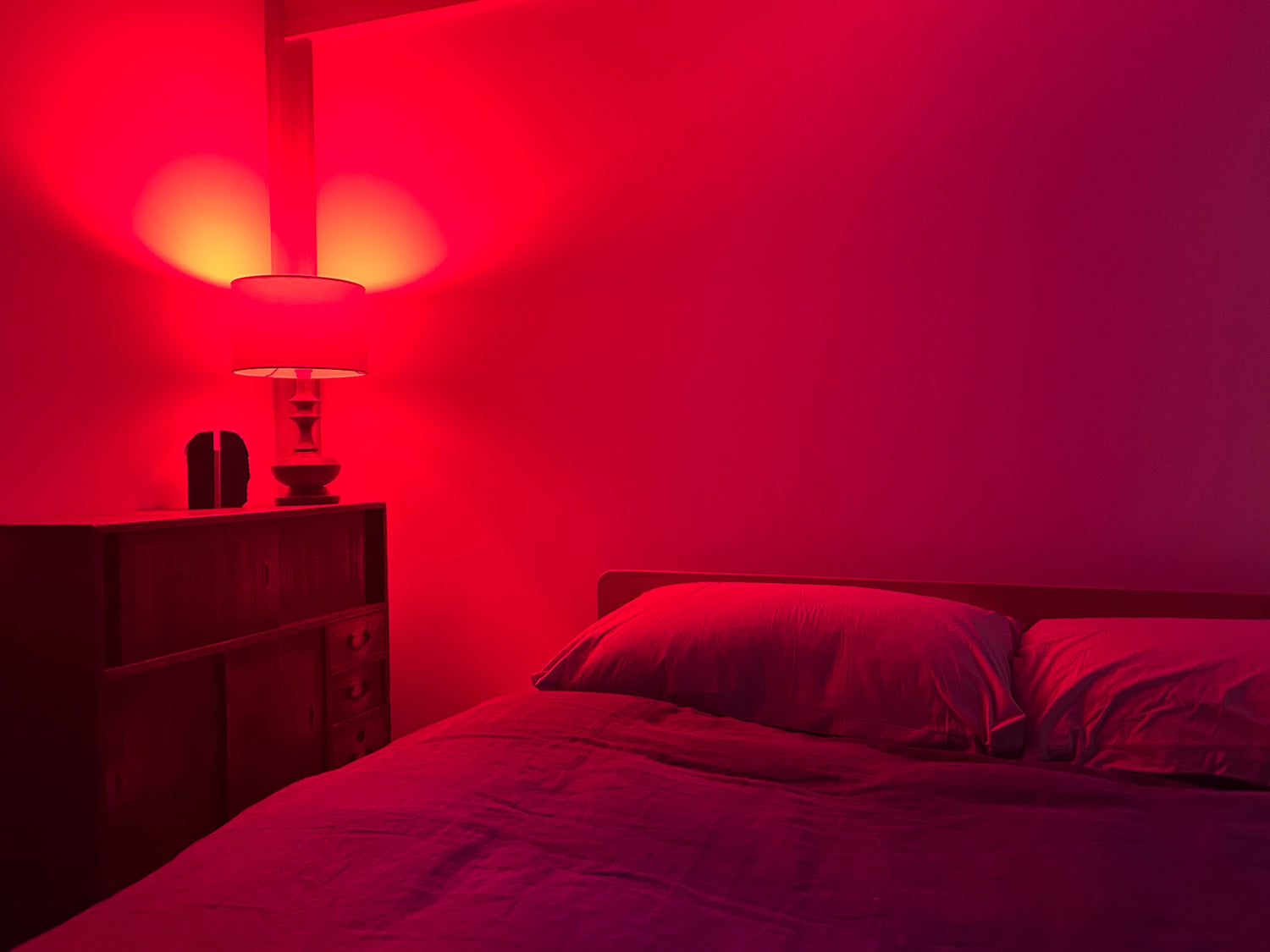
Beside the bed. If you read or wind down with a lamp on, the light source matters. A red globe in a bedside fitting is a low-effort swap.
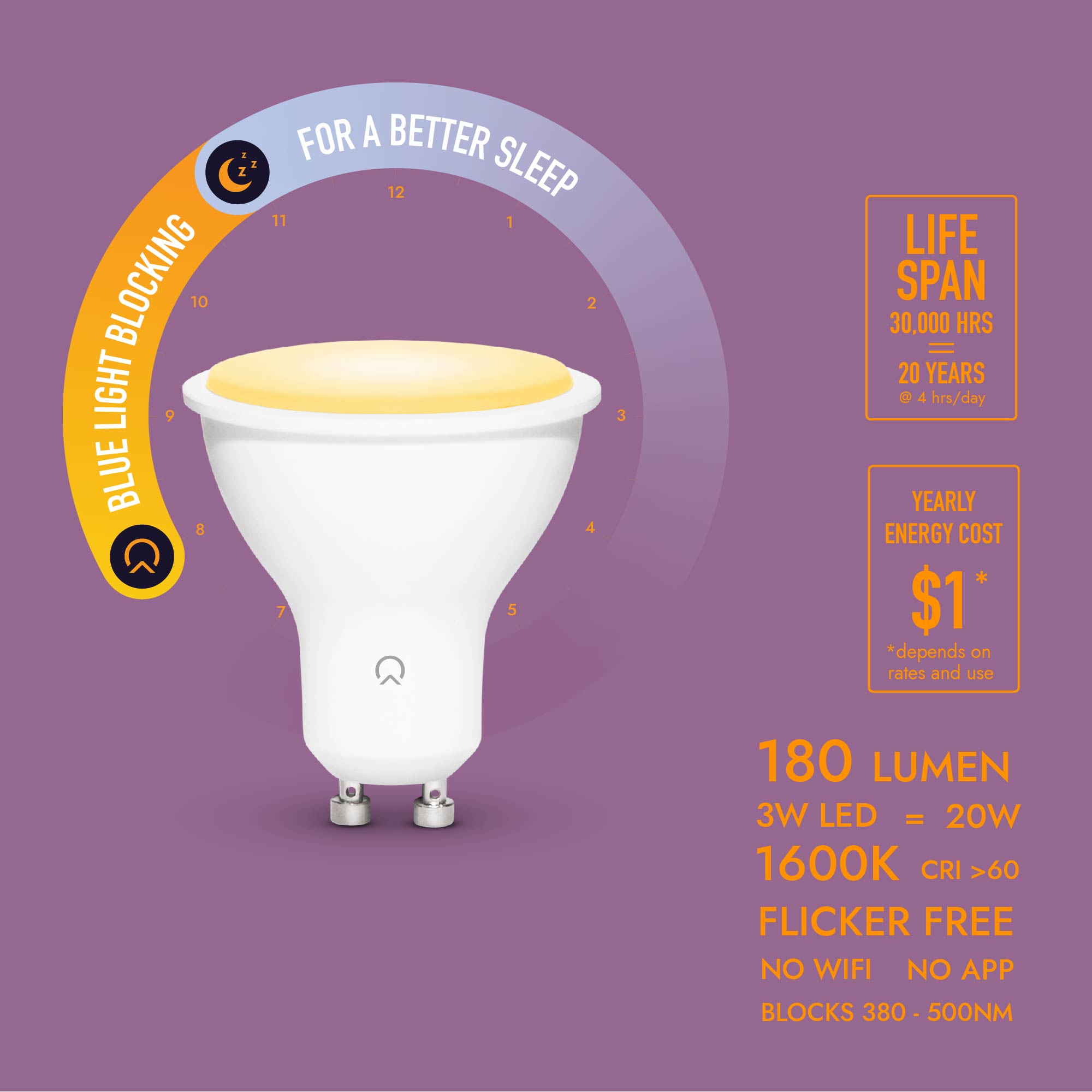
A red light bulb for sleep doesn't need to be complicated. It's a standard fitting, E27 or B22 bayonet in most Australian homes, but with a red-spectrum output that minimises the wavelengths activating melanopsin.
The one scenario where red light makes the biggest difference
Many people who struggle with sleep quality don't have a problem falling asleep. They have a problem with what happens when they wake at 2am or 3am and need to get up briefly. They turn on a light. That light is usually full-spectrum white or blue-white. It's often enough to shift the circadian signal, raise alertness, and make returning to sleep significantly harder.
A motion-activated red night light changes that equation. You get up. The light triggers automatically. It's dim, warm, and red-spectrum. Enough to move around safely without switching on a full lamp. You go back to bed. The signal you sent your brain was not "it's daytime." It was closer to silence.
This is where a motion-activated option has a clear advantage over a manually operated bulb. You don't have to remember to use the right light at 3am. You don't have to make any decision. It handles itself.

What red light won't do
Red light is not a cure for insomnia. It doesn't treat anxiety, doesn't fix sleep apnoea, doesn't reset a circadian rhythm that's been disrupted for years. It's one environmental variable in a system with many variables.
If you've been struggling with sleep for months, the kind where you're wired at bedtime despite being exhausted all day, red lighting alone is unlikely to solve that. What it does is remove one input that may be working against you.
Most people who don't sleep well aren't failing at sleep because of any single thing. They're accumulating small disruptions: late caffeine, bright screens, stress, irregular schedules, and a light environment that keeps their nervous system in daytime mode right up until they get into bed.
Red light addresses that last one. It's a lever. Not the only lever.
How to use red light in your home tonight
Swap your bathroom globe first. It's the highest-impact room for people who wake at night. An E27 or B22 red bulb replaces your standard globe directly. No new fittings needed.
Add a motion-activated red night light to your hallway or bathroom. No decisions at 3am. The right light comes on automatically.
Swap your bedside lamp globe. A red bulb in that fitting keeps your final hour before bed free from melanopsin-activating light.
You don't have to overhaul your whole home. Two rooms, bathroom and hallway, and you've covered the scenarios where blue-spectrum light causes the most disruption.
The Red Night Dream Bulb fits standard E27 and B22 fittings. It's designed for bathroom, hallway, or any room you move through after dark. The Red Night Light - Motion-Activated is the plug-in option that handles the 3am scenario without any manual switch.
Neither of these will fix a decade of bad sleep overnight. But they remove an obstacle that, for many people, has been quietly working against them every single night.


Leave a comment
This site is protected by hCaptcha and the hCaptcha Privacy Policy and Terms of Service apply.