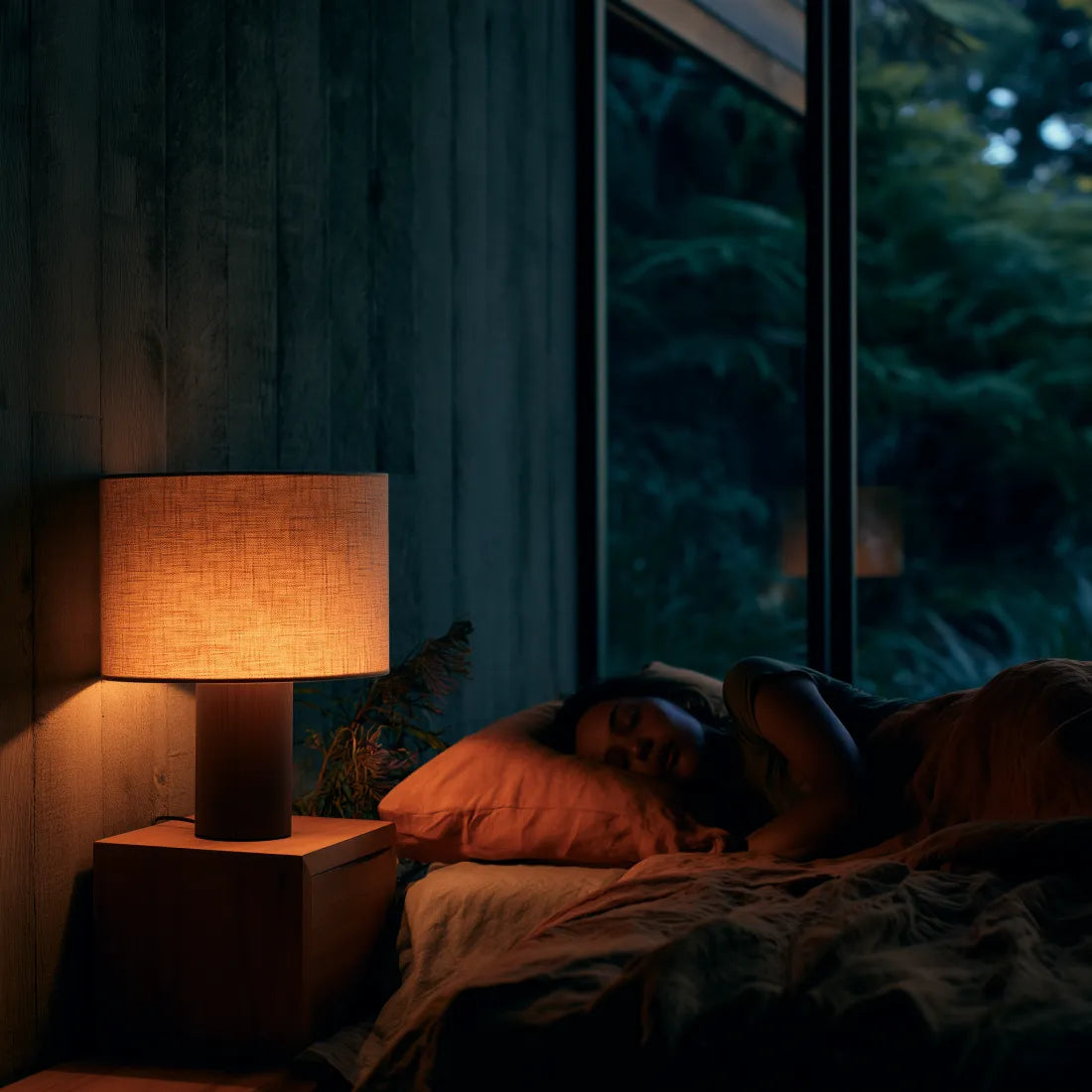
The Complete Sleep Lighting System: Bulbs, Night Lights & Darkness
Which bulbs, night lights, and darkness setup actually protect your melatonin, room by room
TL;DR
- Sleep lighting isn't one product. It's a system: different light for different rooms and times of night.
- Blue and green light suppress melatonin. Red and amber light don't. Complete darkness is the strongest signal of all.
- Bulbs are the biggest single change: swap once, and the effect is automatic every night, in the whole room, not just your eyes.
- Night lights bridge the gap between pitch dark and bright overhead lighting for the moments you need to move around without waking up fully.
- Darkness, worn as a mask or built into the room with curtains, is the final layer once the lights are handled.
- The fastest way to do all of it at once is the Bedroom Overhaul Bundle. The slower way is bulbs first, then add layers as you go.
Your bedroom lighting looks normal. That's the problem.
You're not sleeping under a stadium light. You're sleeping under what feels like ordinary household lighting: an overhead fitting, a bedside lamp, maybe a hallway light left on for the kids. Nothing about it looks like it should be keeping you awake.
But most household lighting is built for daytime. It's bright, and it's full of blue and green wavelengths, the same part of the spectrum your brain uses to know it's morning. At 8am, that's exactly what you want. At 9pm, it's telling your body to stay alert when it should be winding down.
So you lie there "tired," but your brain hasn't got the message. You check your phone, which makes it worse. Thirty, sixty minutes pass before sleep actually starts.
You're not broken. Your lighting is doing the wrong job at the wrong time.
Most advice treats this as a single fix: buy blue light glasses, or a red bulb, or blackout curtains, and you're done. None of those are wrong, but none of them is the whole answer either. Sleep lighting works as a system, different light for different rooms, different light for different times of night, because a bedroom, a bathroom, and a hallway don't need the same thing at 11pm.
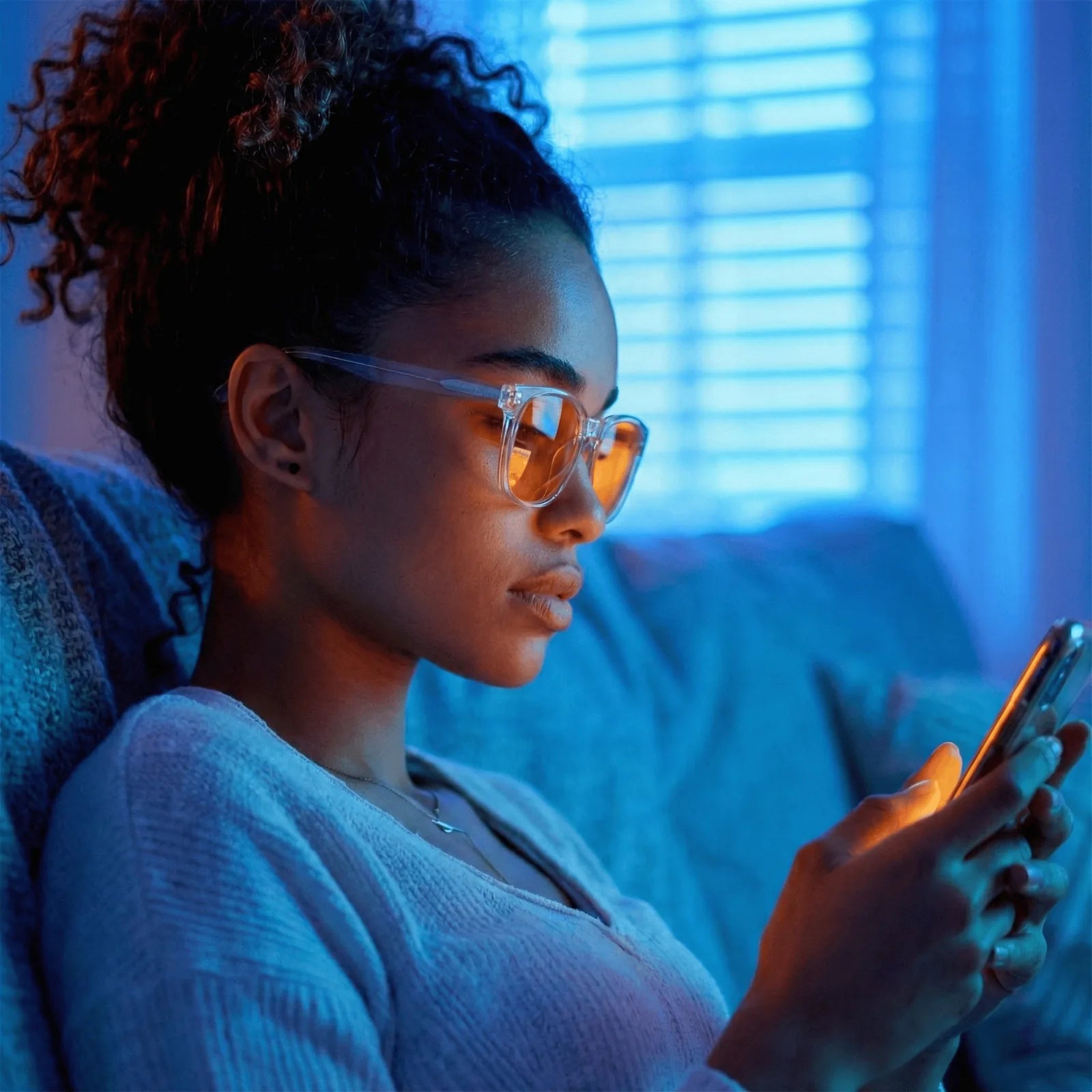
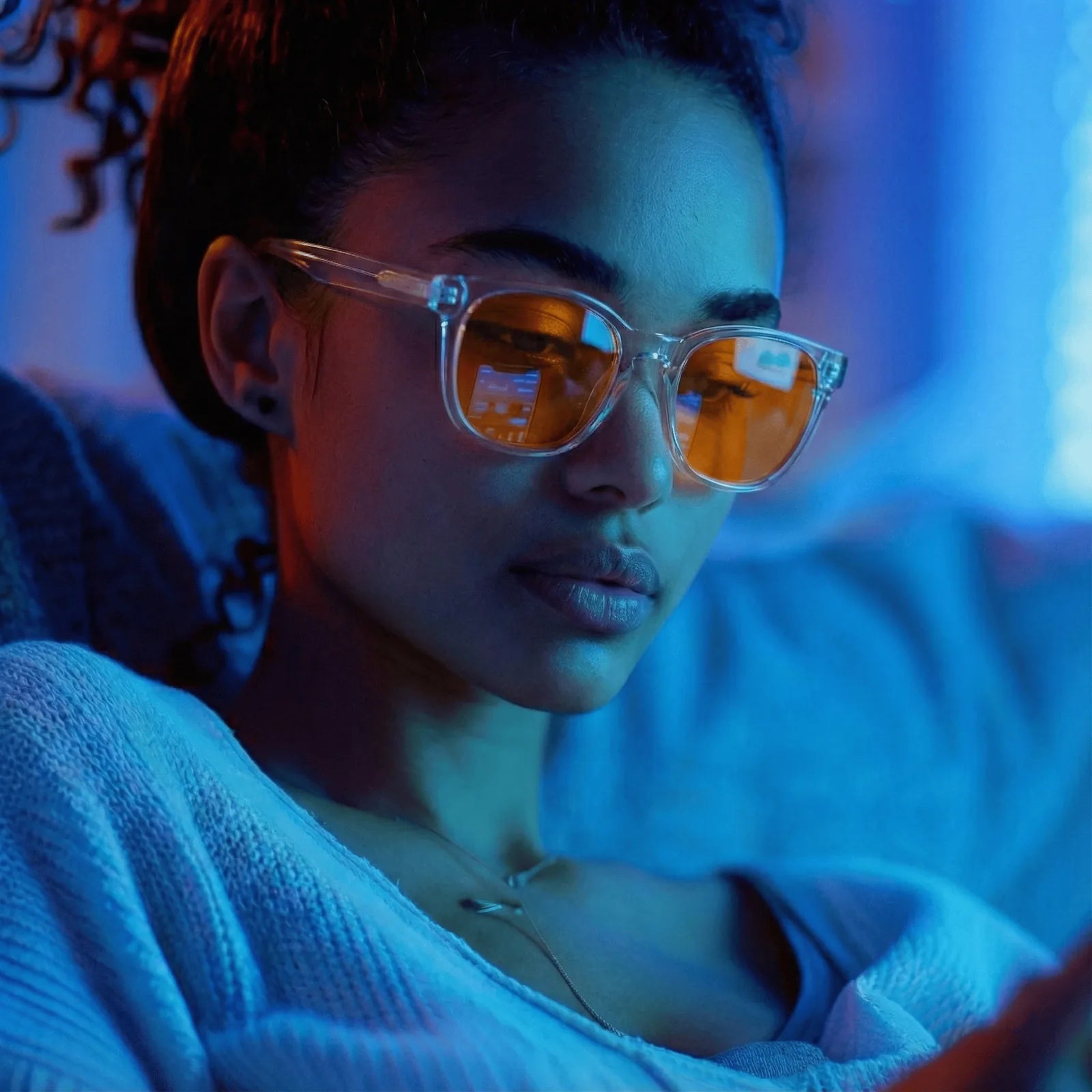
This guide covers that system: which bulbs go where, when a night light earns its place, and how to build real darkness once the lights are sorted. If you also want the personal layer, blue light glasses for screens and reading, that's covered in its own guide, built to be read alongside this one.
By the end, you'll know:
- Why light colour matters more than brightness
- What to put in each room of your home, and why
- When a night light helps and when it just gets in the way
- What a complete setup costs, and where to start if you're not doing it all at once
The Science of Sleep Lighting
What colour temperature actually measures
Light is measured in colour temperature, in Kelvin (K). It's not a measure of brightness, it's a measure of the mix of wavelengths in the light.
- 1200K–1600K: deep amber to red. Candlelight, sunset.
- 2700K–3000K: warm white. Old-style incandescent bulbs.
- 4000K: neutral white. Typical office or kitchen lighting.
- 5000K–6500K: daylight white to cool blue. Midday sun, most LED downlights.
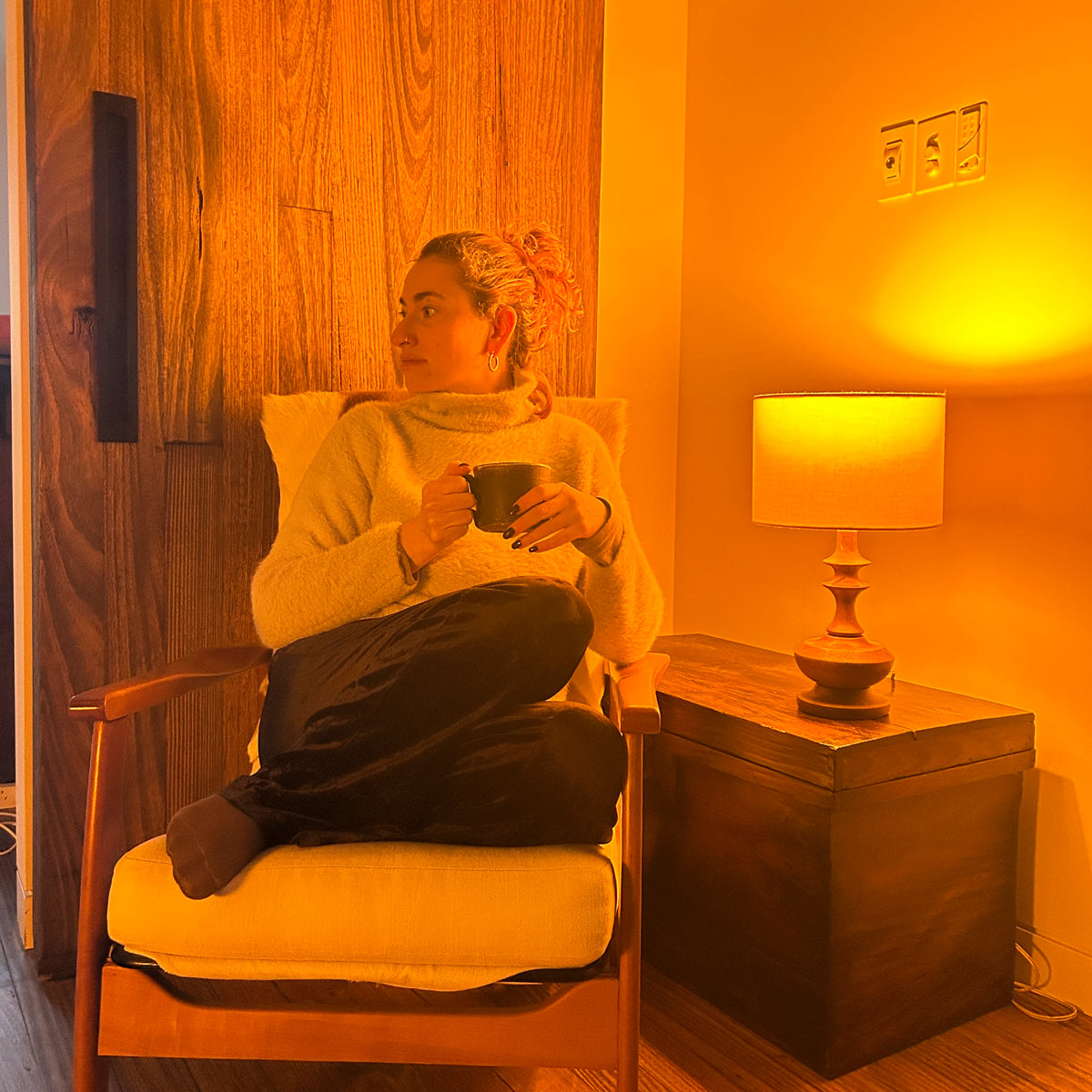
The higher the number, the more blue is in the mix. Your body evolved reading this scale as a clock: warm and low in the morning and evening, cool and high in the middle of the day. Most household bulbs sit at 4000K–5000K all day, which means your 9pm overhead light is telling your circadian system it's early afternoon.
Why blue and green light suppress melatonin
Your eyes have a class of cells separate from the rods and cones that build the image you see. These are melanopsin-containing retinal ganglion cells, and their only job is reporting ambient light levels to your circadian system, not vision.
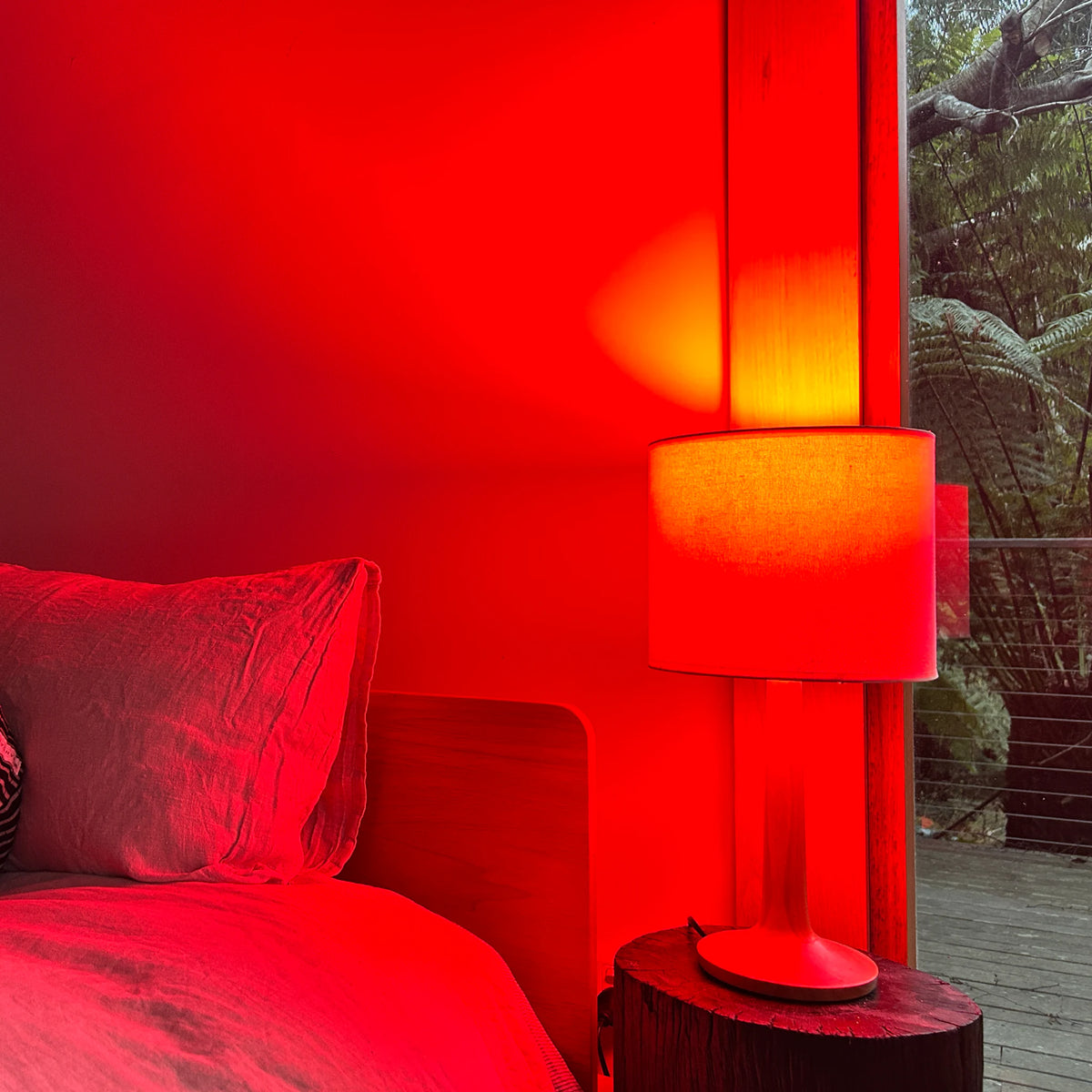
Research mapping the melanopsin action spectrum (Brainard et al.) found the strongest melatonin-suppressing effect concentrated in the blue-violet band, roughly 446–477 nanometres. It tapers off through green, and by the time you reach red wavelengths, the effect is close to zero. This isn't a general "bright light is bad" finding. It's specific to that part of the spectrum, which is exactly why swapping colour matters more than just dimming a blue-heavy light.
A separate study on ordinary room light (Gooley et al.) found that regular indoor room lighting before bedtime, not screens, not anything unusual, suppressed melatonin onset and shortened its duration compared with dim light exposure. The lighting most people already have in their living room is doing this every evening, not just their phone.
What the research shows about red light specifically
A 2025 study comparing red and blue LED light exposed 12 healthy adults to three hours of red (631nm) or blue (464nm) light in the evening, measuring melatonin by saliva sample each hour. After two hours, melatonin under blue light stayed suppressed at 7.5 pg/mL. Under red light, it recovered to 26.0 pg/mL, more than three times higher. The pattern held at three hours. Small study, but a clean, direct comparison: same room, same duration, different wavelength, clearly different result.
Why dimming isn't enough on its own
Turning your regular lights down low feels like it should help, and it does a little, but dimming and changing colour aren't the same intervention.
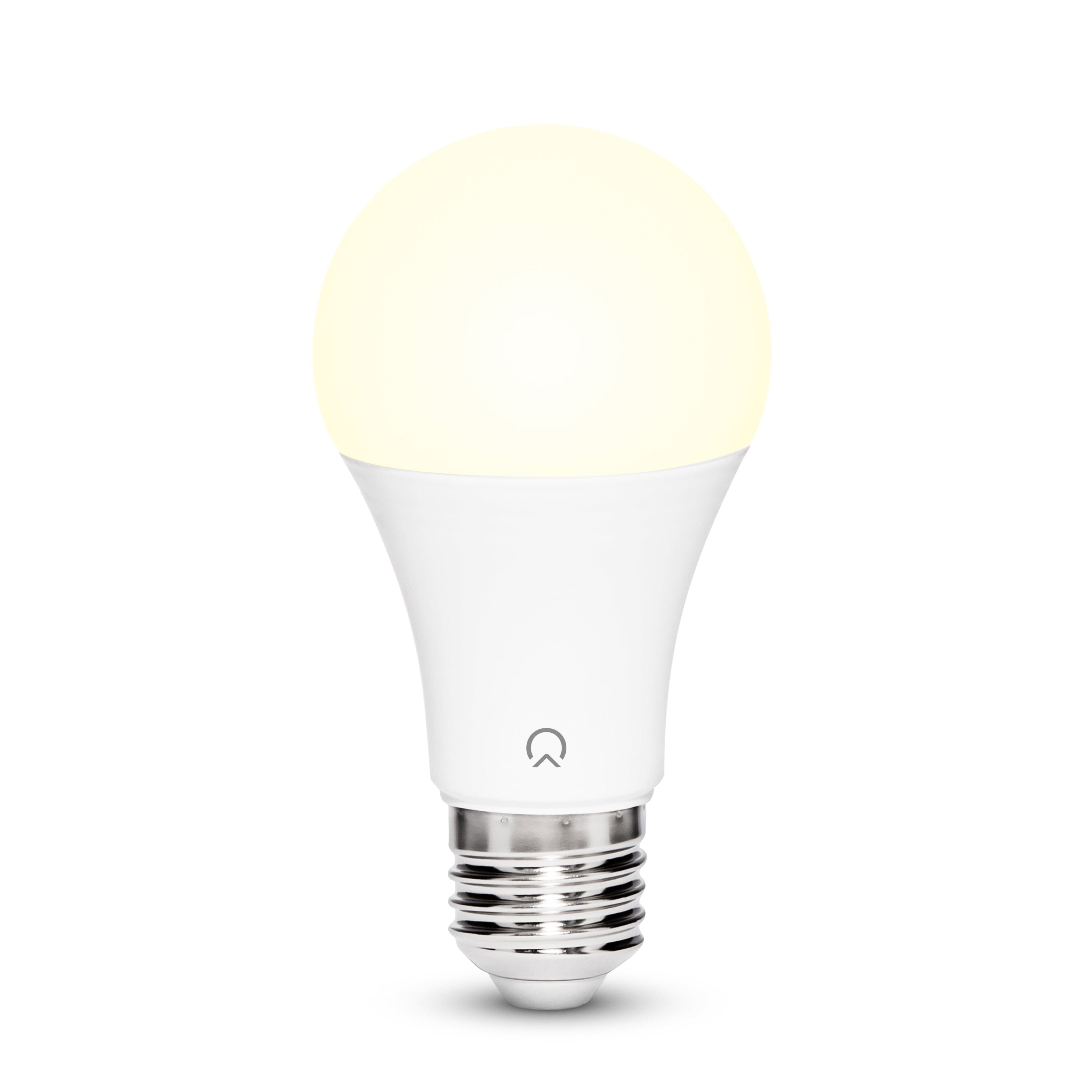
A 4000K bulb at 20% brightness is still a 4000K bulb. It's emitting less total light, but the mix of wavelengths hasn't changed, the blue and green content is still there, just at lower intensity. Melanopsin cells respond to that wavelength band at a wide range of brightness levels, so a dim blue-heavy light still sends a weaker version of the same "stay alert" signal, not a different signal altogether.
This is the gap amber and red bulbs close that dimming can't: they remove the blue and green wavelengths from the light itself, rather than just reducing how much of everything reaches your eyes. Dim your existing lights if you want to as an extra step, but treat it as an addition to switching bulb colour, not a replacement for it.

The circadian rhythm connection
Your circadian rhythm is a roughly 24-hour internal clock, and light is its primary timing cue.
- Morning: blue-rich light (natural sunlight, or a bright cool-white bulb) tells your body the day has started. This is useful. Morning light exposure is standard practice for keeping your clock on schedule.
- Evening: the absence of blue light is meant to signal the day is ending, so melatonin can start rising.
- Evening, with blue light still present: the signal gets confused. Your body gets a "still daytime" message from an overhead light, a screen, or a bright bathroom fitting, right when it should be getting the opposite one.
None of this means you need to sit in the dark from 5pm. It means the light in front of you after sunset should stop containing the wavelengths that read as "daytime" to your circadian system, which is what amber and red light are built to do.
This is what circadian lighting means in practice: not a special category of product, but ordinary bulbs and lamps chosen for their colour temperature instead of just their brightness. Some brands sell this as circadian rhythm lighting, a system that shifts colour through the day on its own schedule. The bulbs below do the same job with a manual switch instead of an app, amber and red for evening, full white for day.
Bulbs: The Foundation
Bulbs are the biggest single change you can make to your sleep lighting, for one reason: they affect the whole room automatically, every night, without anything to remember. Swap the bulb once and the effect is there whether you think about it or not. Compare that to glasses, which only work while you're wearing them, or a routine, which only works if you keep to it.
Amber Glow Sleep Bulb: Your Bedroom Anchor
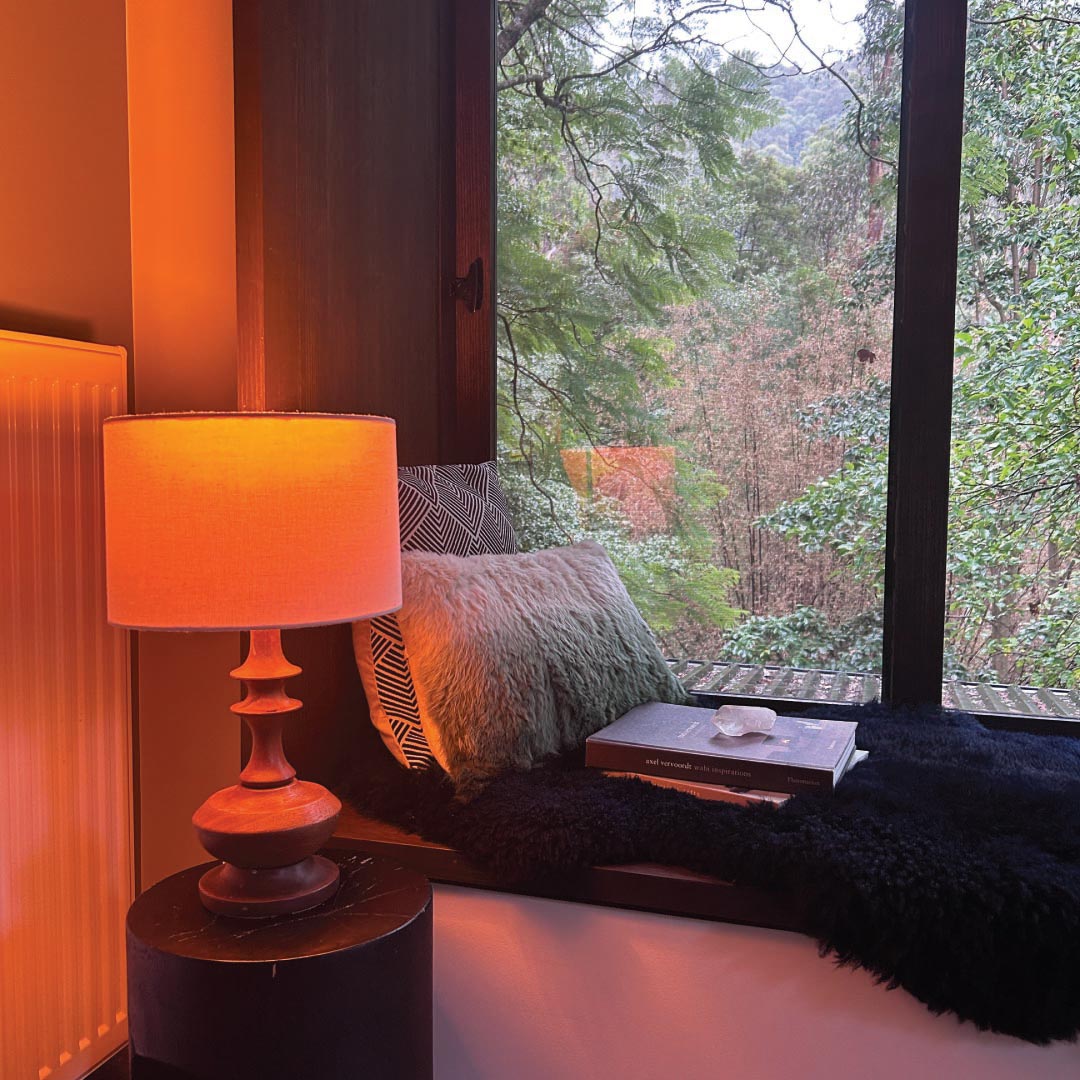
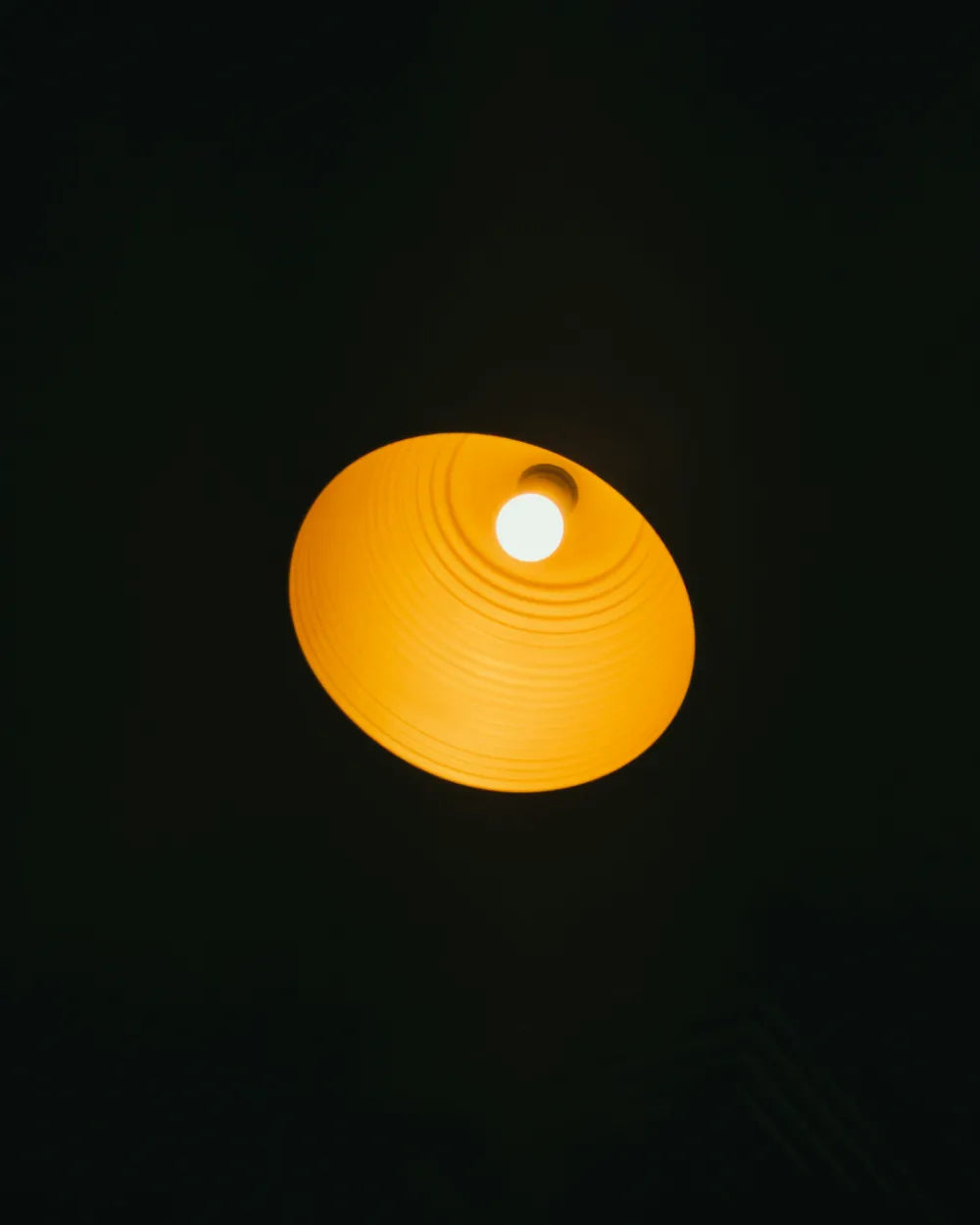
Amber Glow Sleep Bulb, $29.95. 1600K, 420 lumens, 7 watts. Blocks the 380–500nm range completely, the same band the melanopsin research above identifies as the main melatonin suppressor.
Where to use it: bedroom overhead and bedside lamps, living room lighting after sunset, bathroom if you use it before bed.
420 lumens is comparable to a 40-watt incandescent bulb, bright enough to read or move around comfortably, dim enough that it doesn't feel like daytime lighting. It's not for use with dimmer switches, so if you want finer control, use fewer bulbs in the fixture or move to a smaller lamp. E27/E26 screw and B22 bayonet fittings cover most standard sockets; it's also available as a down light bulb in GU10 for downlights and as a small screw bulb in E14 for smaller fittings.
This is the amber light every other amber product in this guide is built around: the Amber Glow bulb, the Amber Sleep Lamp, and the amber night light all use the same 1600K amber lighting. If you've searched for an orange light lamp for your bedroom, this is what that search is looking for, the same warm, blue-free glow, just described differently depending on where you found it.
Shop Amber Glow Bulb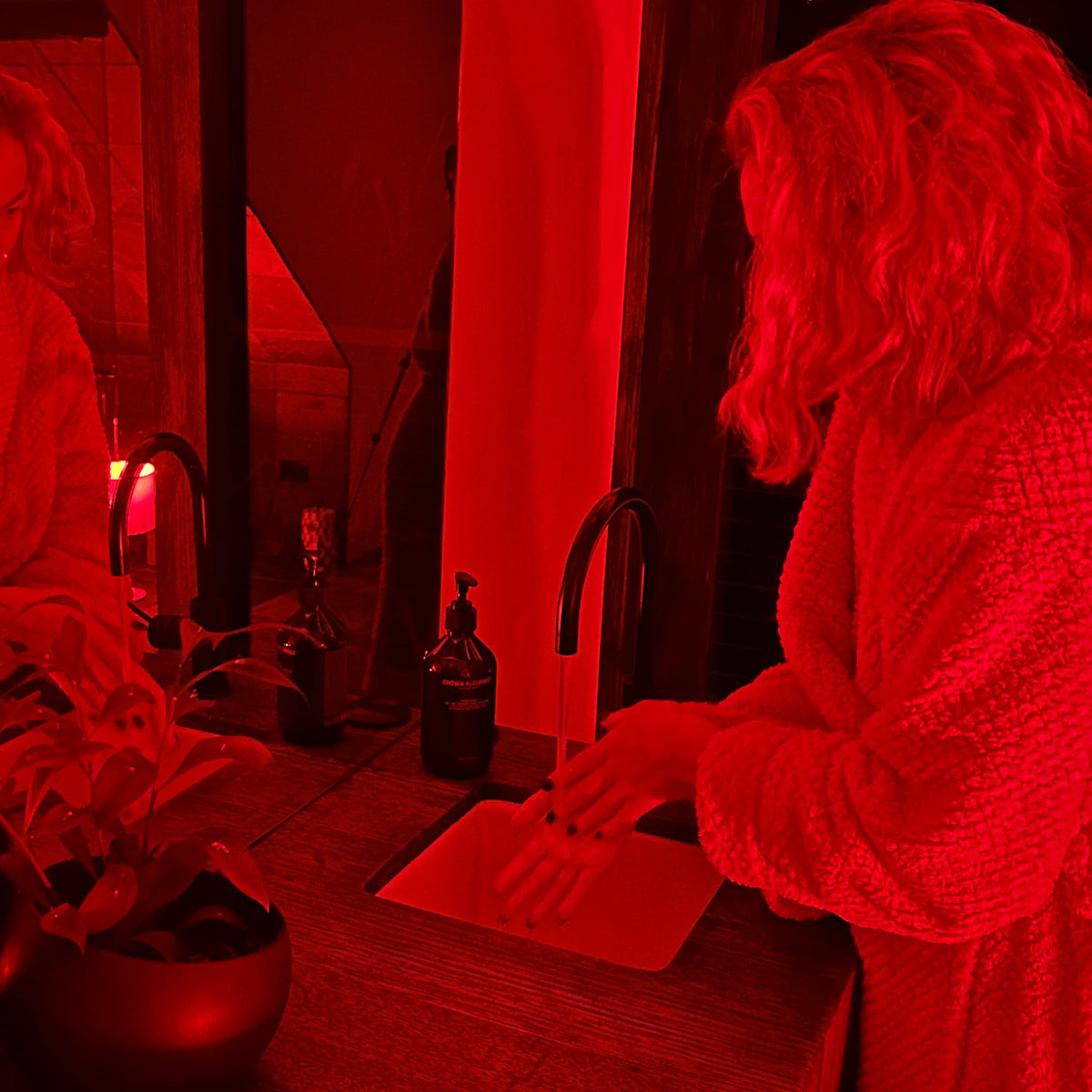
Red Night Light Bulb: For Hallway and Bathroom
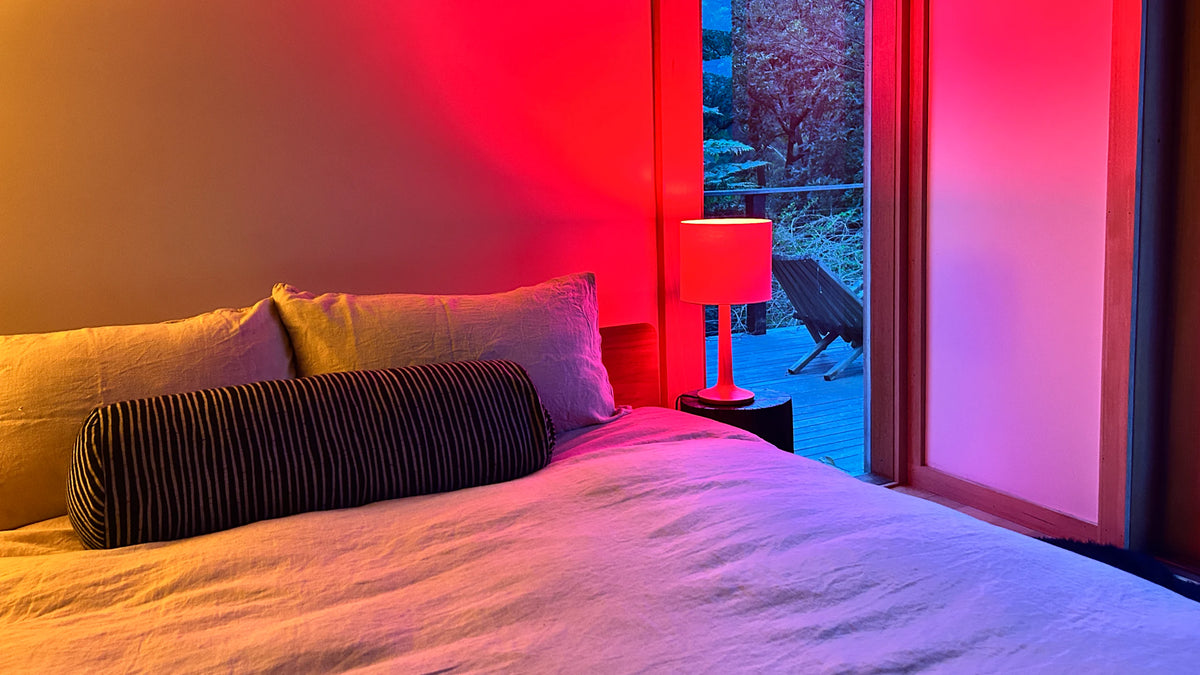
Red Night Light Bulb, $29.95. 350 lumens, 7 watts, peak wavelength 632nm. Measured output has no blue light and 3% green, a wider cut than the amber bulb.
Where to use it: hallway lighting, bathroom lighting for nighttime use, anywhere you need to see well enough to navigate but don't need to read or do anything detailed.
It's dimmer than the amber bulb and reads more obviously as "red-tinted" rather than "warm white," which is exactly the point for a space you're only in briefly at night. Use amber where you're spending time; use red where you're passing through.
If you know bulbs as globes, this is what people are searching for when they look up red light globes or red globes: a globe built to block blue and most of the green spectrum, not just tinted glass over a normal one.
Shop Red Night Light Bulb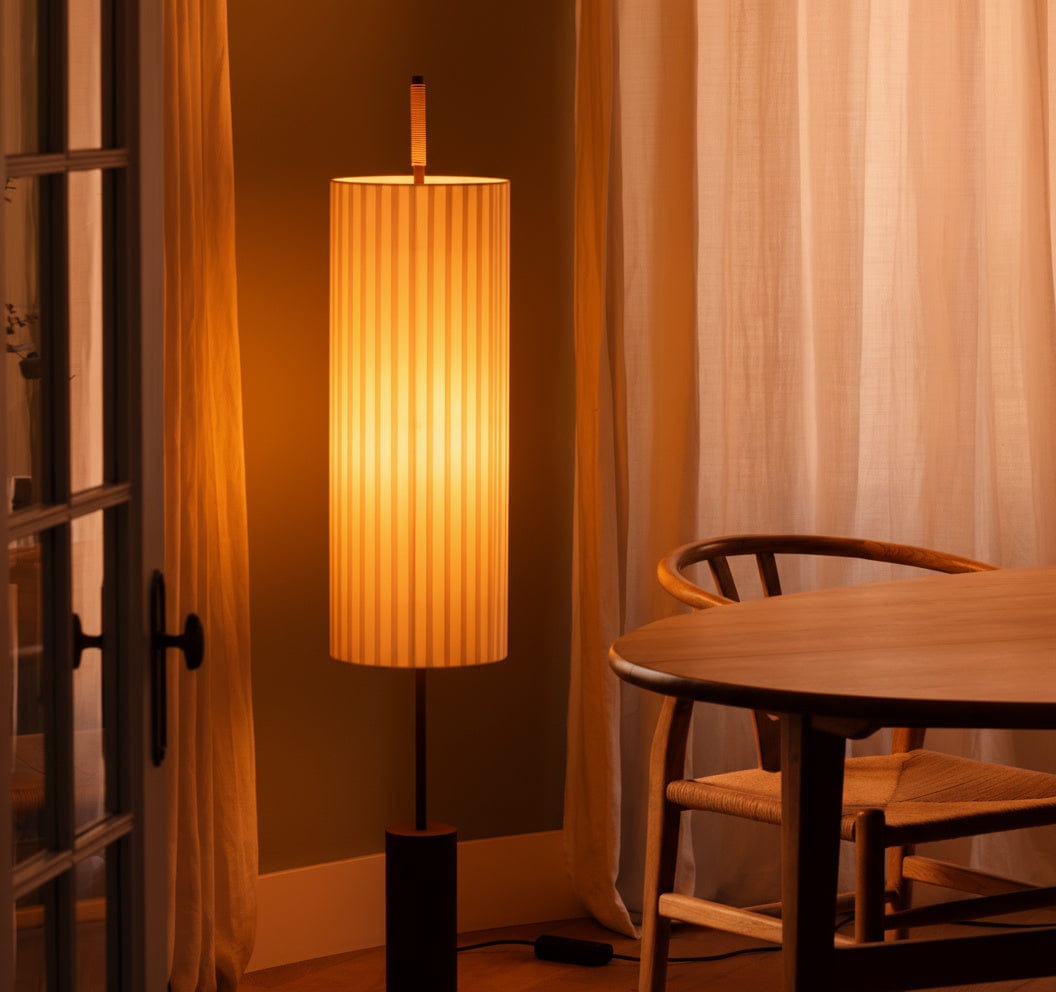
Day+Night Multi Mode Light: One Bulb, Three Modes
Day+Night Multi Mode Light, $34.95. E27/E26 or B22 only, no GU10 or E14. Toggle the light switch off and back on to cycle through modes, no app or remote.
- Day mode: 4000K, full spectrum white light, close to natural daylight, for daytime use
- Mixed mode: 2100K, warm and low-blue, closer to sunset
- Night mode: 1600K, the same 100% blue-free amber as the Amber Glow bulb
Day mode is the closest thing in this range to a full spectrum light bulb or a natural light lamp: broad white light without the amber tint, for whenever the room needs to read as daytime rather than wind-down. The difference between modes isn't a formula, it's a light switch toggle.
630 lumens in daylight mode, the brightest bulb in the range. Good for rooms that need to work both ways: a living room that's bright and functional during the day, then amber in the evening, without swapping bulbs by hand.
Shop Day+Night Multi Mode Light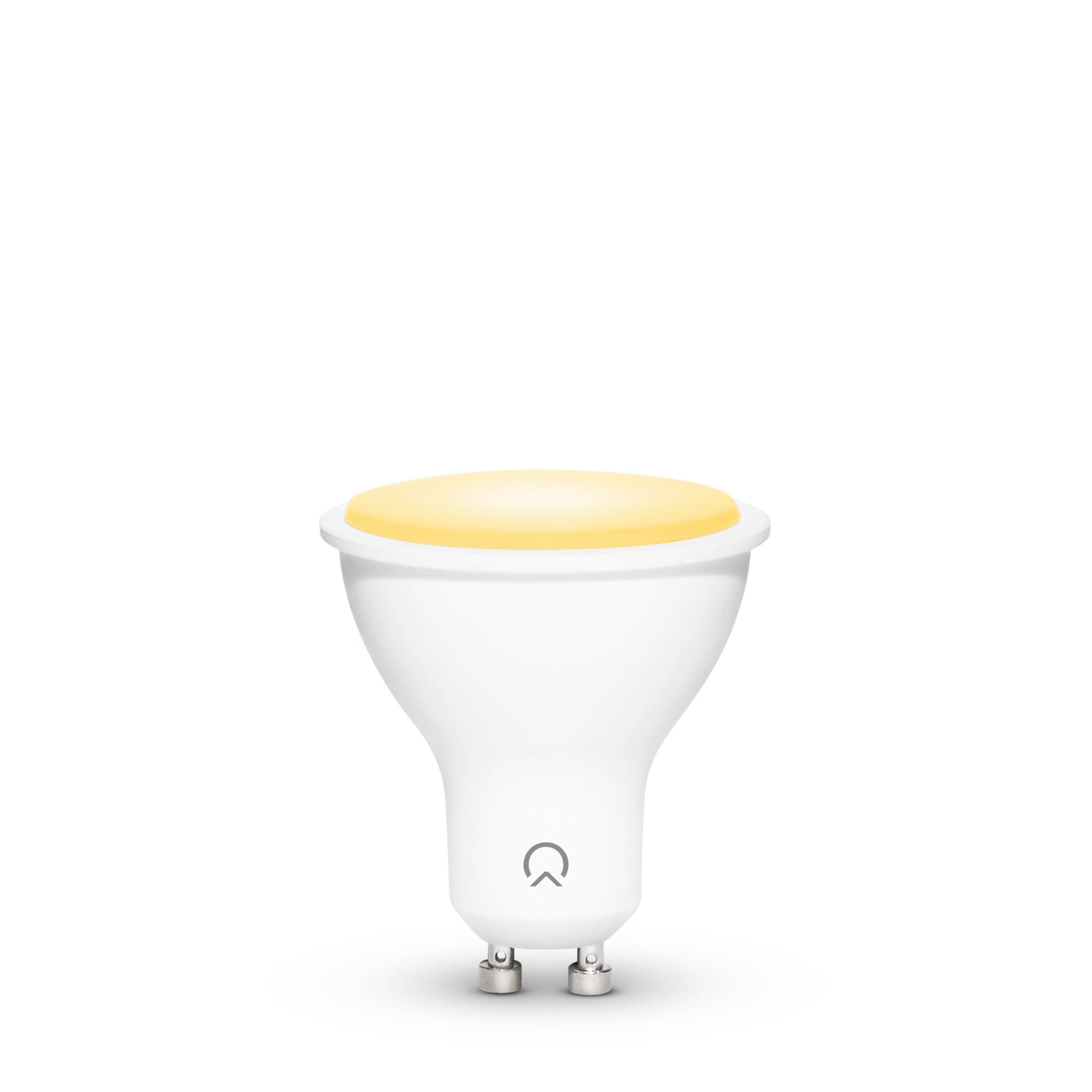
Choosing your fitting
Before buying, check what you actually have:
- E27/E26 (screw): most common for lamps and ceiling lights
- B22 (bayonet): common in Australian ceiling fittings, twist to remove
- GU10 (spotlight): recessed downlights, push-twist install
- E14 (small screw): smaller lamps, some pendant fittings
Wrong fitting means the bulb won't go in, so confirm before you order.
Multi-Mode Blue Blocking Book Light
Not every fix needs an electrician or a landlord's permission. If you're renting, sharing a bedroom with someone who isn't ready to swap the overhead bulb, or just want a bed reading lamp that goes wherever you go, two rechargeable options solve the "book light" problem without touching a single fitting.
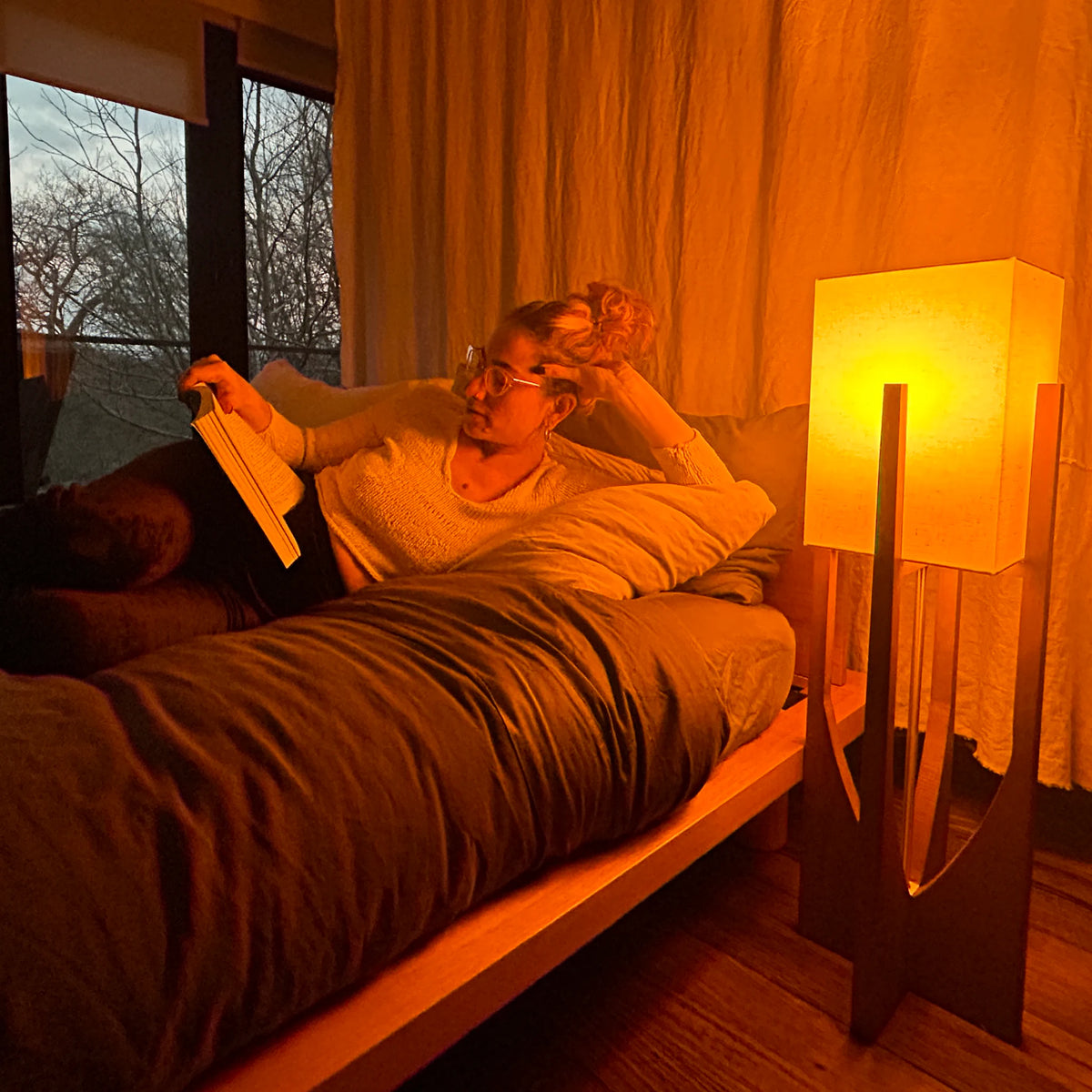
Call it a book lamp clip or a clip-on book light, either way it's the same idea. Multi-Mode Blue Blocking Book Light, $39.95. Rechargeable, 1200mAh, USB-C. Three modes between 1200K and 1600K (amber, sunset, red), a 360° bendable neck, and a clip base that works on a book, a headboard, or a desk. 28cm extended, folds down to 8cm × 8cm.
Shop Book Light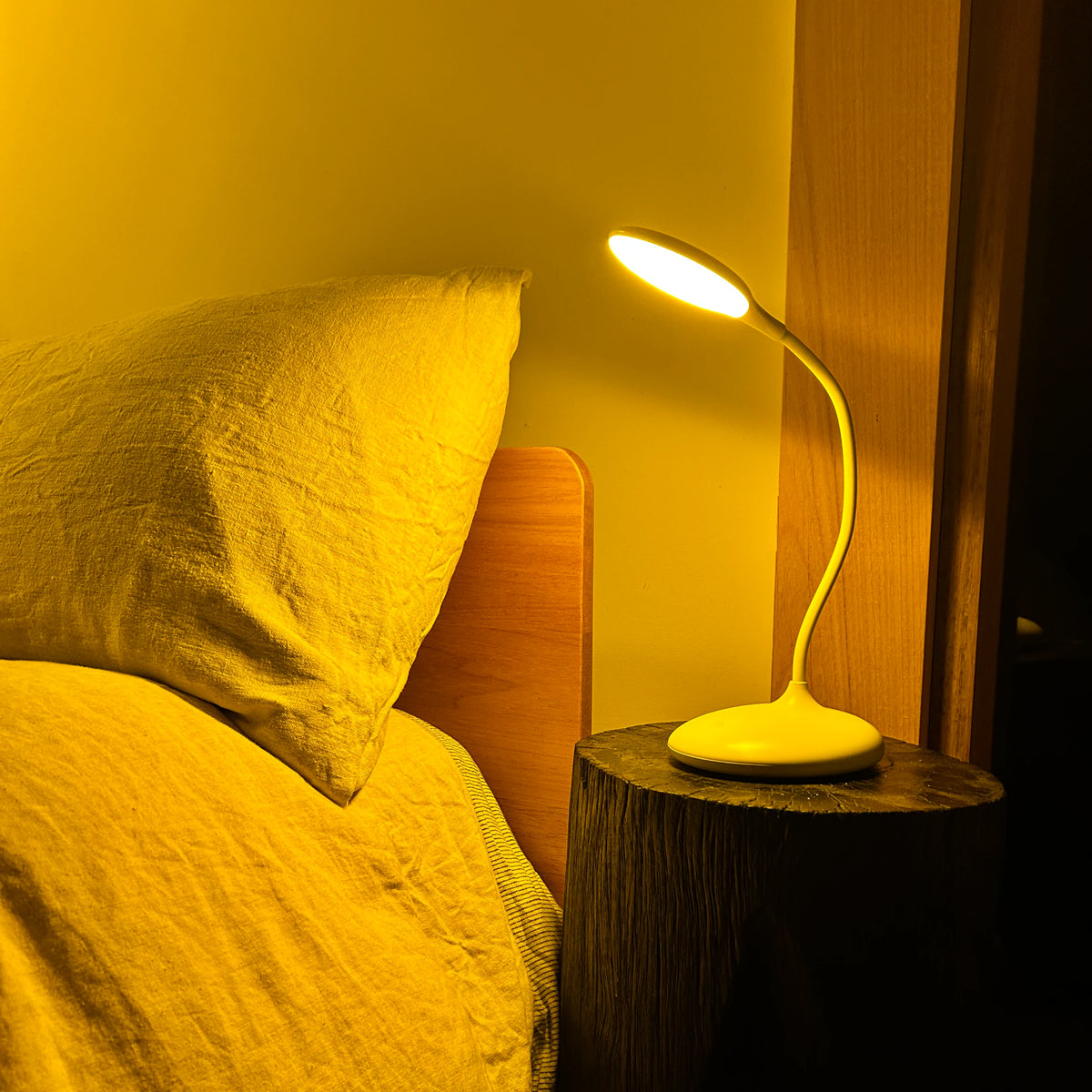
Blue Blocking Amber Sleep Lamp
Blue Blocking Amber Sleep Lamp, $59.95. Rechargeable, 1800mAh, three brightness levels (50, 100, 200 lumens) via touch control. 1600K, 585nm peak. A proper bedside amber lamp rather than a clip light, this sleep lamp runs 40cm extended when unfolded, no blue or green light regardless of brightness level.
Use the book light if you specifically read in bed and want something that clips on. Use the sleep lamp if you want a general bedside light for tasks beyond reading, phone charging, setting things down, checking the time, that stays in the amber range at any brightness.
Shop Amber Sleep LampNight Lights: Hallway & Bathroom
Why they matter
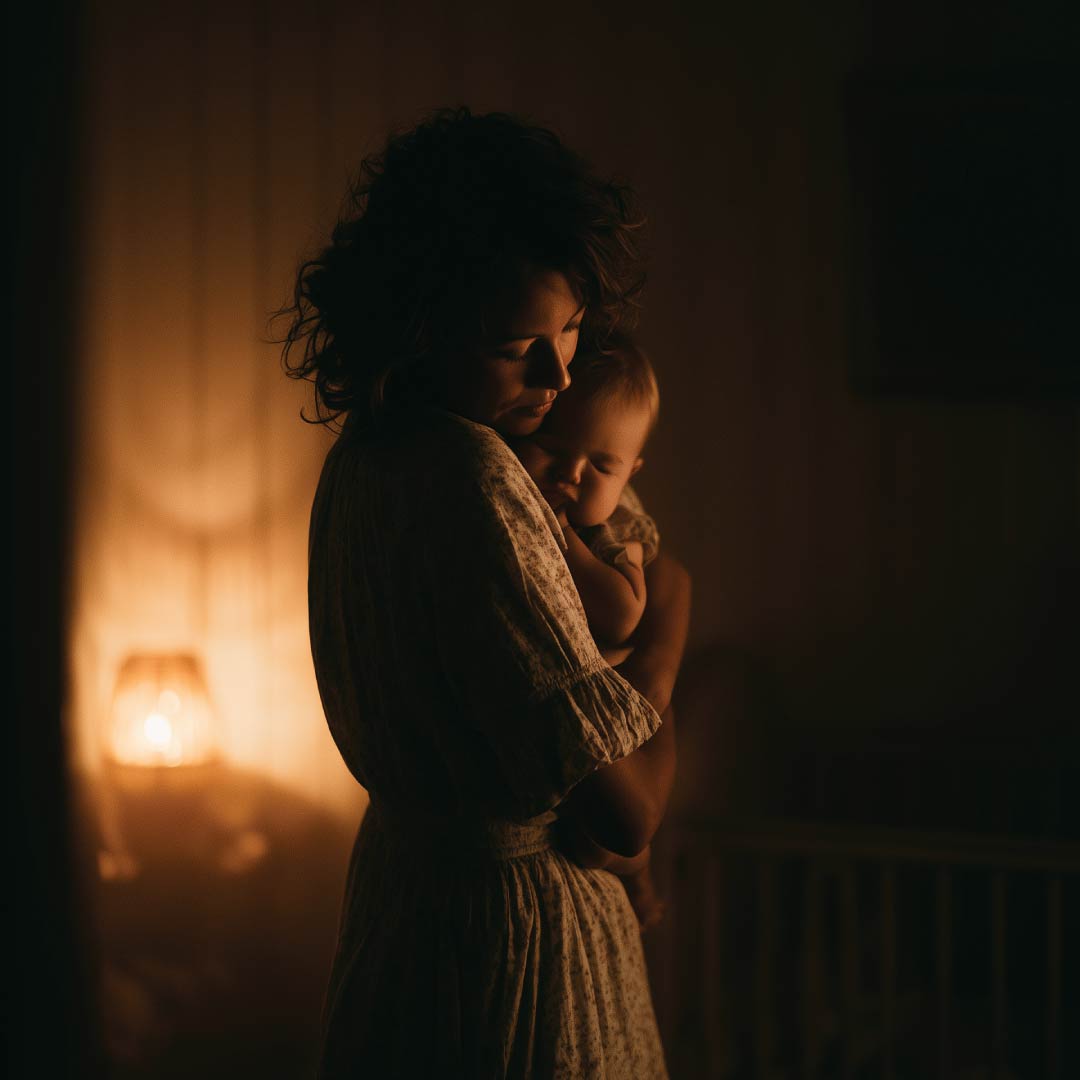
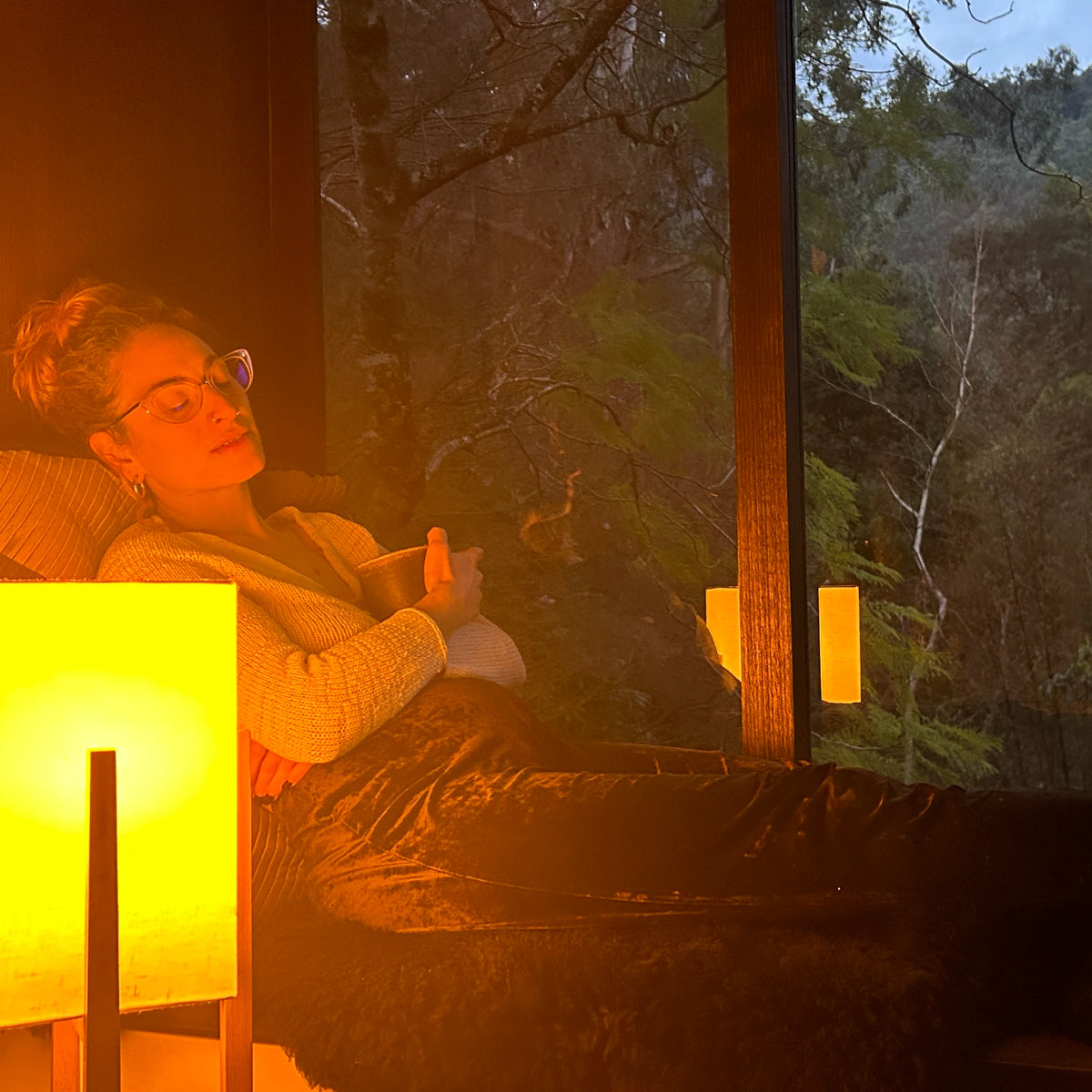
Most homes run on two extremes: pitch dark, so a 3am bathroom trip means feeling your way past furniture, or bright overhead lighting, which fixes the navigation problem and creates a melatonin problem instead. A night light is the middle option: enough light to move safely, none of the wavelengths that fully wake you up. Whether you call it a night lamp, a sensor night light, or a motion sensor night light, the job is the same: a soft red or amber light that only comes on when you need it.
Red or amber: a real choice, not just red
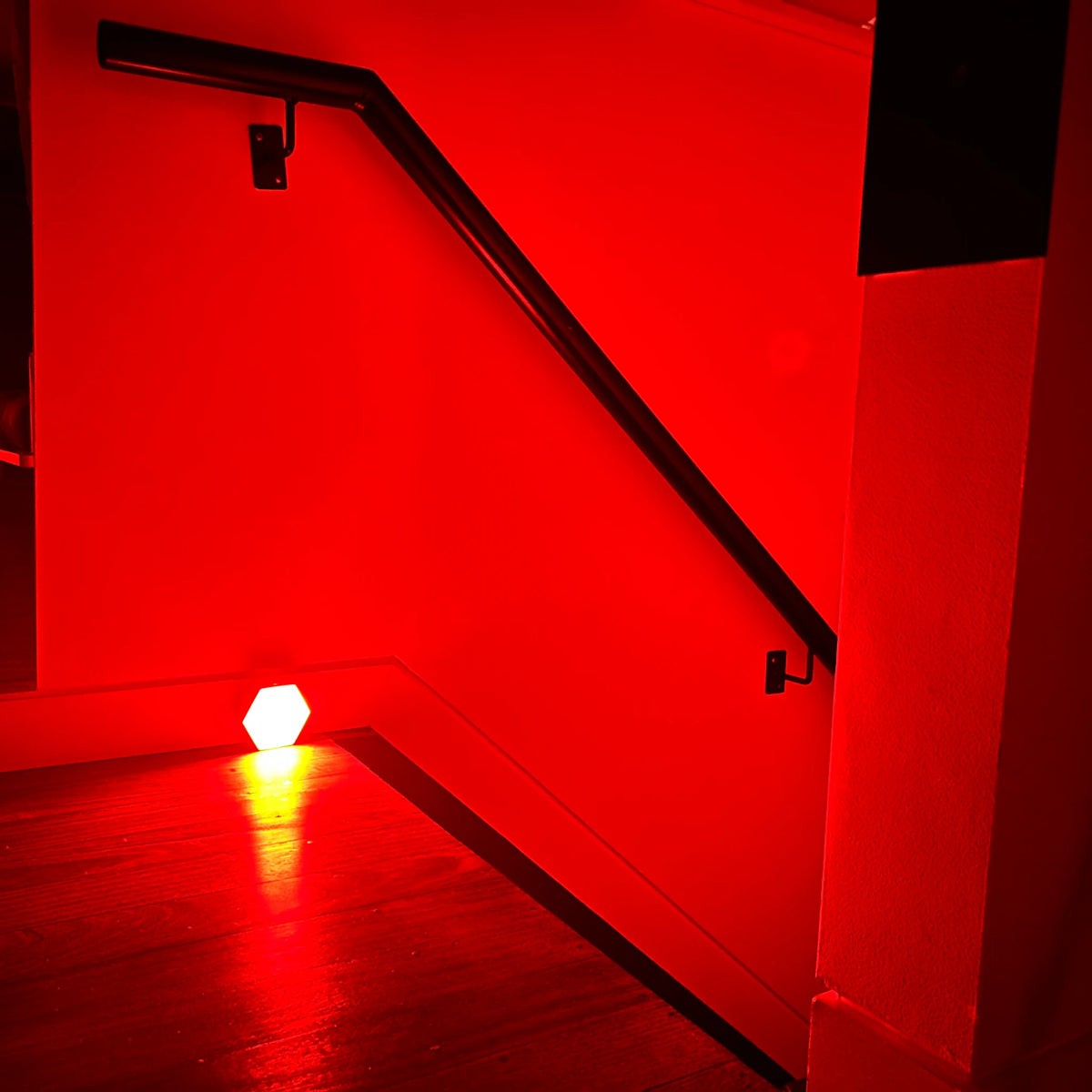
Red Night Light – Motion-Activated and Amber Night Light – Motion-Activated are both $35.95, both rechargeable, both sense motion across 4 metres at a 120-degree angle, and both switch between continuous-on, auto, and off.
The difference is the light itself: red sits at 1200K/80 lumens and blocks blue and most green, about as minimal as light gets while still being useful. Amber sits at 1600K/80 lumens, the same colour as the Amber Glow bulb, slightly more like ordinary warm lighting. If you want a warm night light rather than an obviously red one, this is that option, close enough to a bedside lamp that it doesn't feel clinical, but still built to skip the wavelengths that keep you awake.
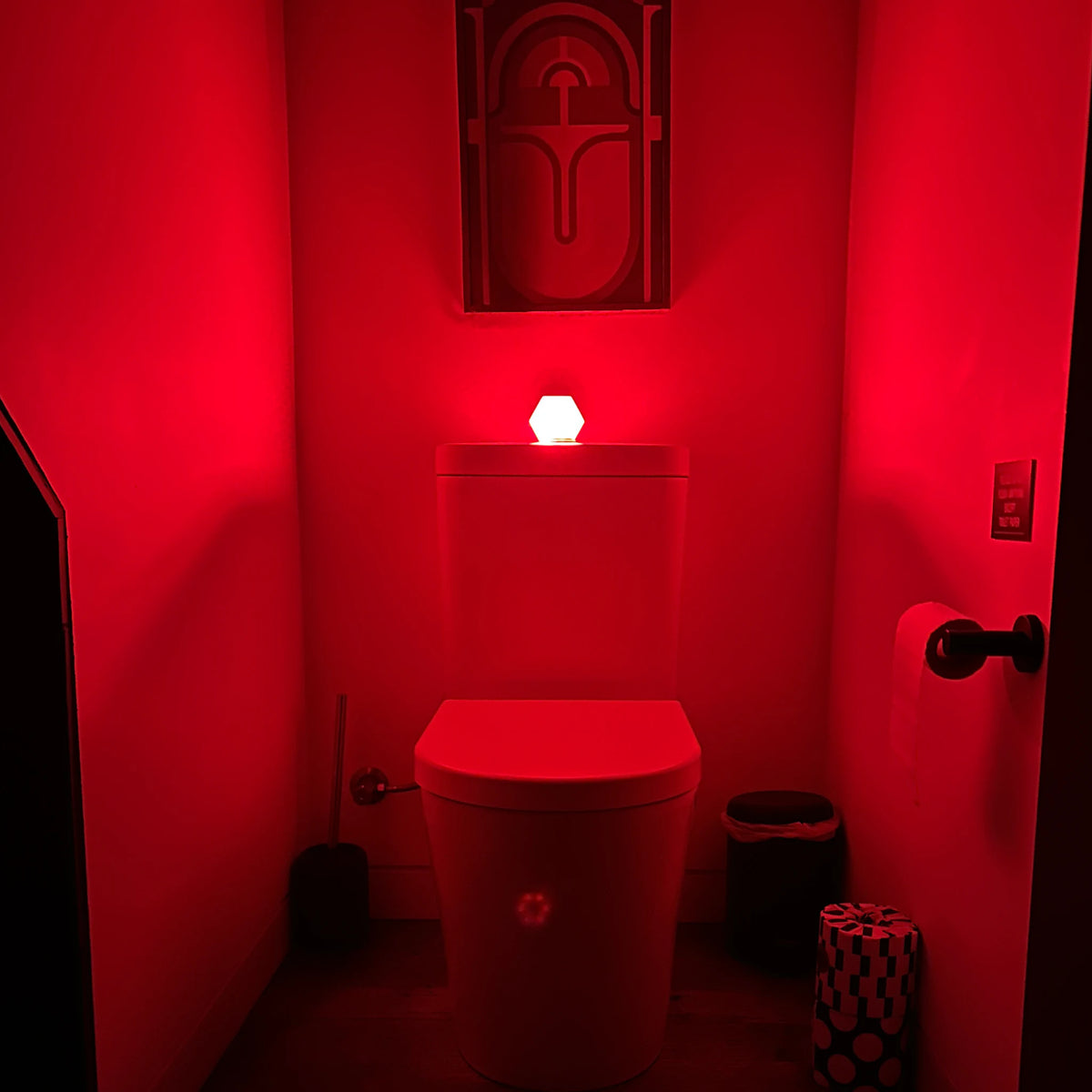
Use red where the only goal is navigation and nothing else, a hallway, a short bathroom trip. Use amber where the space gets used for more than just walking through, a kid's room where they might read for a minute, or a bathroom where you're also brushing your teeth.
Placement
Hallway: one motion-activated light, centred, set to auto so it only turns on when you're actually walking past.
Bathroom: one on the counter or wall, positioned to light the room without shining straight at your face.
Kids' room: low brightness, placed low rather than at eye level, red or amber depending on whether they use the room for anything beyond sleeping.
Generally skip a night light in your own bedroom. Full darkness works better there; the mask and curtain setup below covers that.
Darkness: The Final Layer
Why complete darkness matters
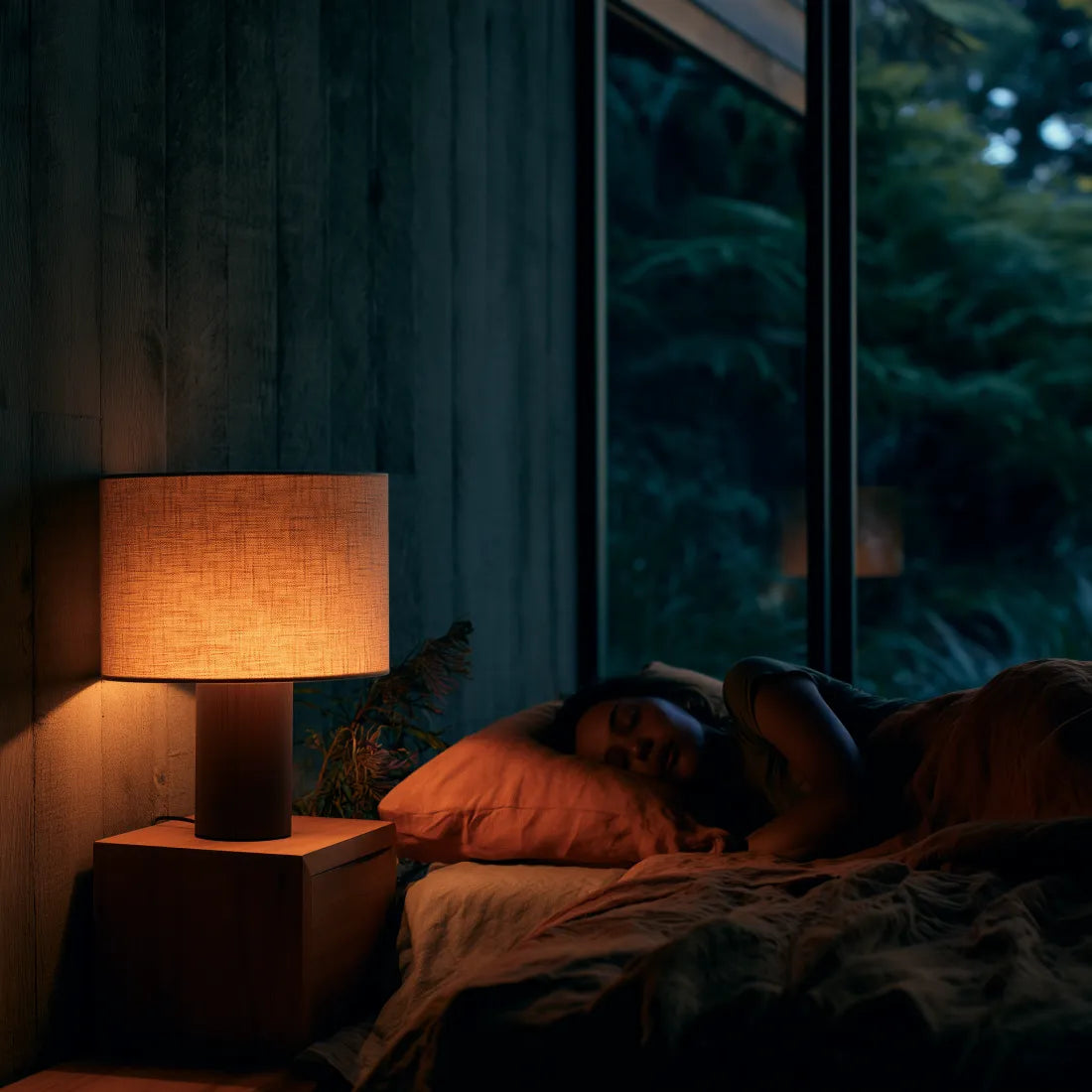
Darkness is the strongest sleep signal your circadian system responds to. Even low-level light, a streetlight through the curtains, a standby LED on the TV, can suppress melatonin by a small amount. It's not much on any single night, but it adds up over weeks of exposure.
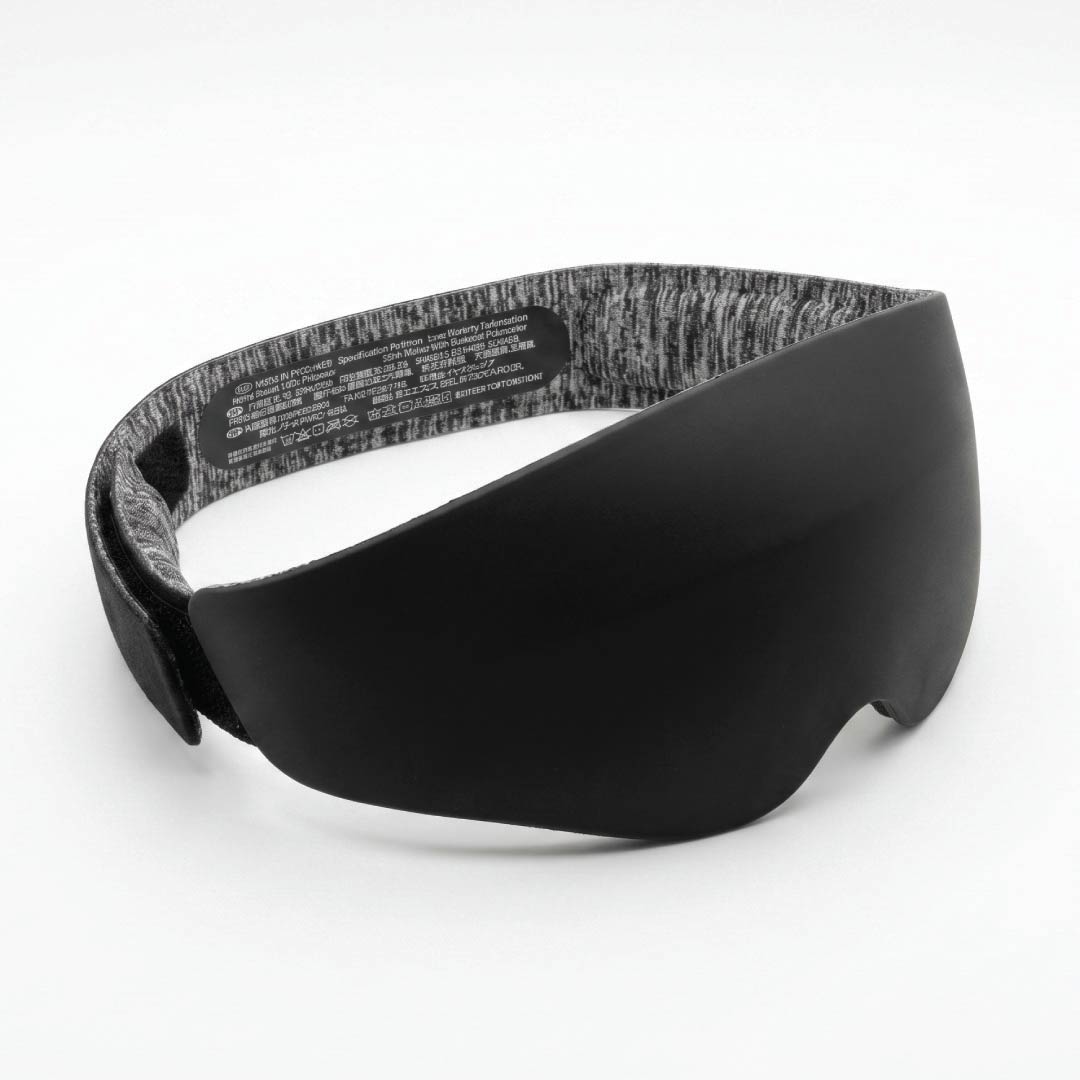
Soma Eclipse: 3D Blackout Sleep Mask
Soma Eclipse, $49.95. A contoured 3D shell means your eyes sit in a cavity rather than under fabric, so there's no pressure on your lids or lashes, one of the more common complaints about flat sleep masks. Adjustable velcro strap, machine washable, works for side sleepers.
A mask is the fastest way to get to full darkness: no installation, works in a hotel room or on a plane, and it solves the "my partner reads with the light on" problem without either of you compromising.
Shop Soma Eclipse Sleep MaskBlackout curtains
Not a Soma product, but worth including because it's the other real path to darkness. Blackout curtains handle the whole room rather than just your eyes, which matters if you'd rather not sleep in a mask every night, or if streetlight through your window is the main issue. They cost more upfront and need installing, but they're a one-time fix once they're up.
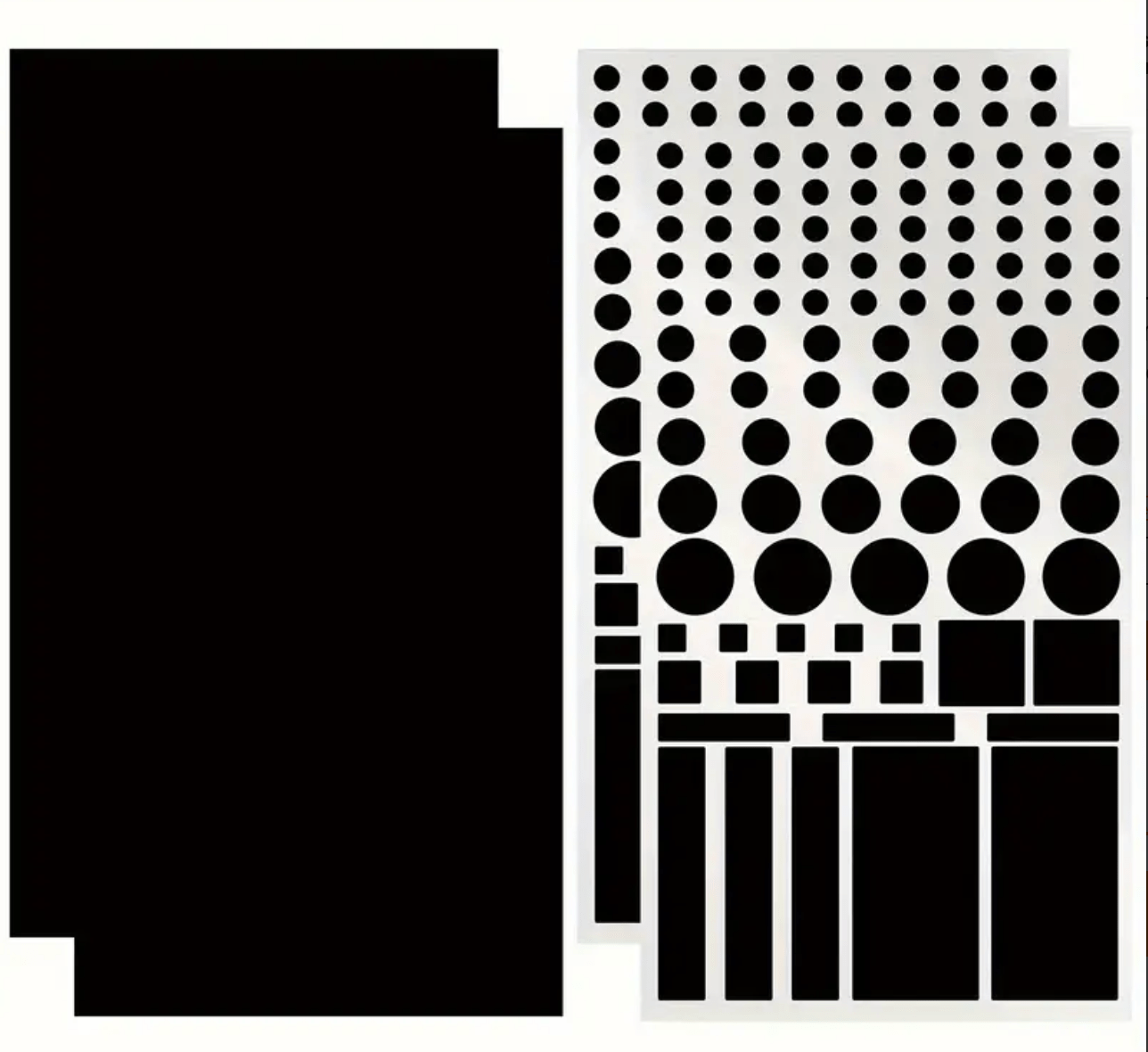
NoGlow LED Light Blocking Stickers
NoGlow LED Light Blocking Stickers, $14.95. Four sheets, two at 80–100% blackout for full coverage, two at 50–80% for dimming rather than fully hiding a light you still want to glance at. Covers router lights, TV standby indicators, alarm clocks, anything with a small always-on LED.
Darkness checklist: sleep mask or blackout curtains (pick one, or both if streetlight is bad), LED stickers on any device with a standby light, overhead lights dimmed or switched to amber for the last hour before bed.
Shop LED Light Blocking Stickers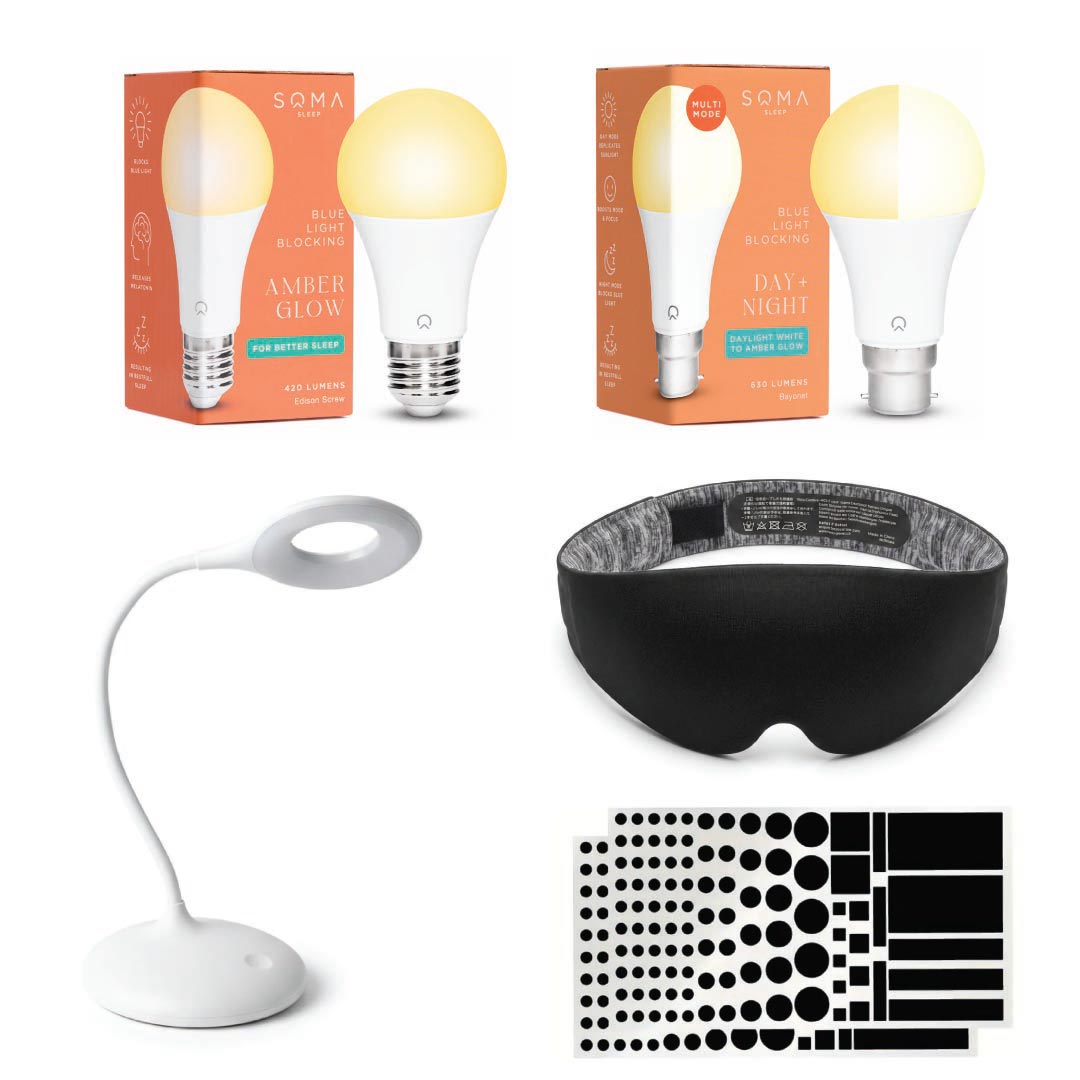
The Complete System, Room by Room
Bedroom
Amber Glow bulb, Amber Sleep Lamp, Day+Night bulb, Soma Eclipse mask, and LED stickers cover the room. That's the same five pieces in the Bedroom Overhaul Bundle: bought separately at current prices they total $189.75, against $129.95 bundled, a $59.80 saving.
Bathroom
Red Night Light Bulb for nighttime use. If you also use the bathroom as part of a wind-down routine before bed, an Amber Glow bulb for the mirror light avoids the harsher red tone while you're actually in there.
Hallway
One motion-activated night light, red or amber depending on preference.
Living Room
Day+Night Multi Mode bulb, so the room stays bright and functional during the day and switches to amber in the evening without a bulb change.
Kids' Room
Motion-activated night light, amber if they read or need some visibility, red if the goal is pure navigation.
A full five-room setup with one bulb or light per room runs somewhere between $150 and $260 depending on how many fittings each room needs. Start with the bedroom. It's where the effect matters most and the change is easiest to notice.
Shop the Bedroom Overhaul BundleBlack Friday 2026. Change four or more rooms and every light is 50% off, with a free Soma Eclipse sleep mask at seven. Early access opens 16 November. See the Black Friday sale
Comparing Your Options
- Amber Glow bulb only: $29.95. Swap one bulb. Best for the fastest single change, bedroom.
- Red Night Light Bulb: $29.95. Swap one bulb. Best for hallway and bathroom navigation.
- Book light or bedside lamp: $39.95 to $59.95. None, plug and use. Best for renters, shared rooms, reading.
- Motion night light: $35.95. Plug in, mount. Best for 3am trips and kids' rooms.
- Soma Eclipse sleep mask: $49.95. None. Best for the fastest path to full darkness.
- Bedroom Overhaul Bundle: $129.95. A few minutes to install everything. Best for the whole bedroom in one purchase.
The bundle is the only option here that covers bulb, bedside lighting, and darkness in a single purchase. Individual products are the lower-commitment way to test whether the change is worth it to you before going further.
Frequently Asked Questions About Sleep Lighting
Should I use amber or red bulbs in my bedroom?
Amber. It's brighter (420 lumens vs. 350) and reads as warm lighting rather than an obvious red tint, better suited to a room you spend real time in. Save red for hallways and bathrooms, spaces you're only passing through.
Do I need blackout curtains if I already have the Eclipse mask?
No. The mask alone gets you to full darkness. Curtains are for people who'd rather not wear a mask every night, or who want the whole room dark rather than just their eyes.
What if my partner wants the light on?
The Eclipse mask solves this without either of you compromising: you get full darkness, they keep whatever light they're using. If you'd rather both adjust the room, agree on amber lighting only after a set time in the evening.
Do I need both the book light and the bedside lamp?
Not usually. The book light is built for clipping onto a book or headboard, better if you specifically read in bed. The Amber Sleep Lamp is a general bedside light with more brightness range, better if you want something for tasks beyond reading. Most people only need one.
How long until I notice a difference?
Most people notice a change within the first week of consistent use. Bulbs work automatically once installed, so the main variable is whether you're actually using amber or red lighting in the evening instead of switching back to the old bulbs out of habit.
I'm renting. Can I still do this?
Yes. Bulbs are reversible, unscrew the amber one and put the old bulb back when you move. The book light and bedside lamp need no installation at all. Blackout curtains are the one item here that assumes a longer-term setup.
Does this conflict with morning light therapy?
No. Bright, cool light in the morning is what sets your circadian rhythm for the day, amber and red lighting in the evening is what protects it once the day is over. Keep bright light to mornings and amber or red to evenings, rather than mixing the two in the same window.
Is a night light better than leaving the hallway light on?
Yes, on both counts that matter: a red or amber night light doesn't carry the blue and green wavelengths a normal hallway light does, and motion-activated versions only turn on when you're actually there, rather than running all night regardless of whether anyone's using the hallway.
What's the fastest way to get started if I only do one thing?
An Amber Glow bulb in your bedroom. It's the single change most people notice first, costs under $30, and takes a few minutes to install.
Can I just use a smart bulb instead, and change the colour with an app?
You can, and some smart bulbs do let you shift colour temperature through the evening. The trade-off is cost and complexity: smart bulbs typically run $25–40 each and need a bridge or app to manage, and you're relying on remembering to change the setting (or trusting an automation to fire correctly) rather than a fixed-colour bulb doing the same job with nothing to configure. If you already have a smart lighting setup you're happy with, use it. If you're starting from nothing, a fixed amber bulb is simpler and one less app to maintain.
Are these bulbs actually worth it long-term, given they cost more than a normal bulb?
Amber and red bulbs cost $29.95 against $5–10 for a standard bulb. They're covered by a 2 year warranty, and they run at 7 watts, so the running cost is a few dollars a year. The upfront cost is higher. What you're buying is a bulb built to keep blue light out of your evening, which a supermarket LED is not.
Are red or amber night lights safe to use in a baby's or toddler's room?
Yes. Both run at 80 lumens on battery power, low heat, no exposed globe, and the whole point of using red or amber over a standard night light is reducing the blue and green wavelengths that would otherwise disrupt their sleep the same way it disrupts yours. Set it to auto so it's not running all night on a fixed cycle, only when there's movement in the room.
Building the System
None of this needs to happen in one weekend. The bulbs matter most, and everything else is a layer you can add once you've noticed the bulbs are working.
If you want the fast path, the Bedroom Overhaul Bundle covers the bulb, the bedside lamp, the darkness layer, and the small device-light fixes in one purchase for $129.95, against $189.75 if you bought each piece separately. If you'd rather test the water first, start with a single Amber Glow bulb in your bedroom, then add a night light for the hallway, then darkness once you're confident the lighting change is doing something for you.
This guide covers the room. If you also want the personal layer, blue light glasses for the hour or two before bed when you're still on a screen or reading, that's covered separately. The two work well together: the room stops working against you, and the glasses cover the gap while you're still awake in it.